


Page 16 - Demo
P. 16
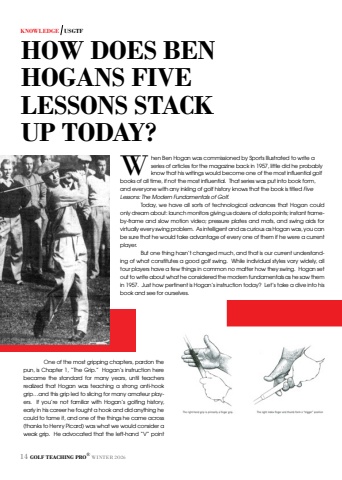
GOLF TEACHING PRO%u00ae 14 WINTER 2O26KNOWLEDGE USGTFWhen Ben Hogan was commissioned by Sports Illustrated to write a series of articles for the magazine back in 1957, little did he probably know that his writings would become one of the most influential golf books of all time, if not the most influential. That series was put into book form, and everyone with any inkling of golf history knows that the book is titled Five Lessons: The Modern Fundamentals of Golf.Today, we have all sorts of technological advances that Hogan could only dream about: launch monitors giving us dozens of data points; instant frameby-frame and slow motion video; pressure plates and mats, and swing aids for virtually every swing problem. As intelligent and as curious as Hogan was, you can be sure that he would take advantage of every one of them if he were a current player.But one thing hasn%u2019t changed much, and that is our current understanding of what constitutes a good golf swing. While individual styles vary widely, all tour players have a few things in common no matter how they swing. Hogan set out to write about what he considered the modern fundamentals as he saw them in 1957. Just how pertinent is Hogan%u2019s instruction today? Let%u2019s take a dive into his book and see for ourselves.HOW DOES BEN HOGANS FIVE LESSONS STACK UP TODAY?One of the most gripping chapters, pardon the pun, is Chapter 1, %u201cThe Grip.%u201d Hogan%u2019s instruction here became the standard for many years, until teachers realized that Hogan was teaching a strong anti-hook grip%u2026and this grip led to slicing for many amateur players. If you%u2019re not familiar with Hogan%u2019s golfing history, early in his career he fought a hook and did anything he could to tame it, and one of the things he came across (thanks to Henry Picard) was what we would consider a weak grip. He advocated that the left-hand %u201cV%u201d point


