


Page 47 - Demo
P. 47
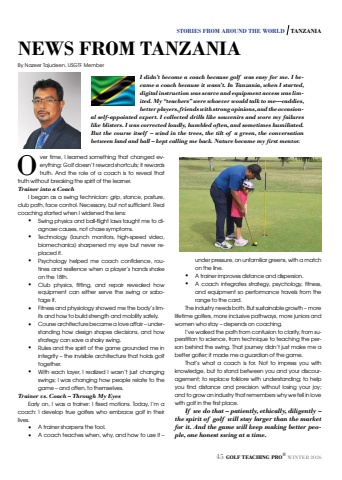
GOLF TEACHING PRO%u00ae 45 WINTER 2O26Over time, I learned something that changed everything: Golf doesn%u2019t reward shortcuts; it rewards truth. And the role of a coach is to reveal that truth without breaking the spirit of the learner.Trainer into a CoachI began as a swing technician: grip, stance, posture, club path, face control. Necessary, but not sufficient. Real coaching started when I widened the lens:%u2022 Swing physics and ball-flight laws taught me to diagnose causes, not chase symptoms.%u2022 Technology (launch monitors, high-speed video, biomechanics) sharpened my eye but never replaced it.%u2022 Psychology helped me coach confidence, routines and resilience when a player%u2019s hands shake on the 18th.%u2022 Club physics, fitting, and repair revealed how equipment can either serve the swing or sabotage it.%u2022 Fitness and physiology showed me the body%u2019s limits and how to build strength and mobility safely.%u2022 Course architecture became a love affair %u2013 understanding how design shapes decisions, and how strategy can save a shaky swing.%u2022 Rules and the spirit of the game grounded me in integrity %u2013 the invisible architecture that holds golf together. %u2022 With each layer, I realized I wasn%u2019t just changing swings; I was changing how people relate to the game %u2013 and often, to themselves.Trainer vs. Coach %u2013 Through My EyesEarly on, I was a trainer: I fixed motions. Today, I%u2019m a coach: I develop true golfers who embrace golf in their lives.%u2022 A trainer sharpens the tool.%u2022 A coach teaches when, why, and how to use it %u2013 under pressure, on unfamiliar greens, with a match on the line.%u2022 A trainer improves distance and dispersion.%u2022 A coach integrates strategy, psychology, fitness, and equipment so performance travels from the range to the card.The industry needs both. But sustainable growth %u2013 more lifetime golfers, more inclusive pathways, more juniors and women who stay %u2013 depends on coaching.I%u2019ve walked the path from confusion to clarity, from superstition to science, from technique to teaching the person behind the swing. That journey didn%u2019t just make me a better golfer; it made me a guardian of the game.That%u2019s what a coach is for. Not to impress you with knowledge, but to stand between you and your discouragement; to replace folklore with understanding; to help you find distance and precision without losing your joy; and to grow an industry that remembers why we fell in love with golf in the first place.If we do that %u2013 patiently, ethically, diligently %u2013 the spirit of golf will stay larger than the market for it. And the game will keep making better people, one honest swing at a time.I didn%u2019t become a coach because golf was easy for me. I became a coach because it wasn%u2019t. In Tanzania, when I started, digital instruction was scarce and equipment access was limited. My %u201cteachers%u201d were whoever would talk to me%u2014caddies, better players, friends with strong opinions, and the occasional self-appointed expert. I collected drills like souvenirs and wore my failures like blisters. I was corrected loudly, humbled often, and sometimes humiliated. But the course itself %u2013 wind in the trees, the tilt of a green, the conversation between land and ball %u2013 kept calling me back. Nature became my first mentor.NEWS FROM TANZANIASTORIES FROM AROUND THE WORLD TANZANIABy Nazeer Tajudeen, USGTF Member


