


Page 9 - Demo
P. 9
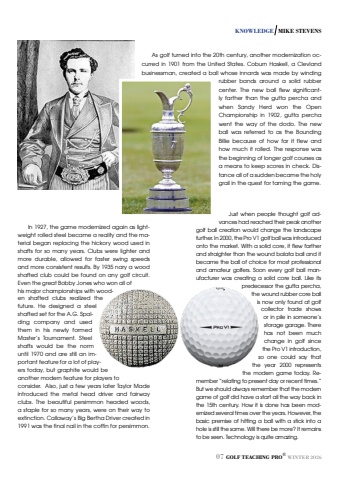
GOLF TEACHING PRO%u00ae 07 WINTER 2O26KNOWLEDGE MIKE STEVENSAs golf turned into the 20th century, another modernization occurred in 1901 from the United States. Coburn Haskell, a Clevland businessman, created a ball whose innards was made by winding rubber bands around a solid rubber center. The new ball flew significantly farther than the gutta percha and when Sandy Herd won the Open Championship in 1902, gutta percha went the way of the dodo. The new ball was referred to as the Bounding Billie because of how far it flew and how much it rolled. The response was the beginning of longer golf courses as a means to keep scores in check. Distance all of a sudden became the holy grail in the quest for taming the game. In 1927, the game modernized again as lightweight rolled steel became a reality and the material began replacing the hickory wood used in shafts for so many years. Clubs were lighter and more durable, allowed for faster swing speeds and more consistent results. By 1935 nary a wood shafted club could be found on any golf circuit. Even the great Bobby Jones who won all of his major championships with wooden shafted clubs realized the future. He designed a steel shafted set for the A.G. Spalding company and used them in his newly formed Master%u2019s Tournament. Steel shafts would be the norm until 1970 and are still an important feature for a lot of players today, but graphite would be another modern feature for players to consider. Also, just a few years later Taylor Made introduced the metal head driver and fairway clubs. The beautiful persimmon headed woods, a staple for so many years, were on their way to extinction. Callaway%u2019s Big Bertha Driver created in 1991 was the final nail in the coffin for persimmon. Just when people thought golf advances had reached their peak another golf ball creation would change the landscape further. In 2000, the Pro V1 golf ball was introduced onto the market. With a solid core, it flew farther and straighter than the wound balata ball and it became the ball of choice for most professional and amateur golfers. Soon every golf ball manufacturer was creating a solid core ball. Like its predecessor the gutta percha, the wound rubber core ball is now only found at golf collector trade shows or in pile in someone%u2019s storage garage. There has not been much change in golf since the Pro V1 introduction, so one could say that the year 2000 represents the modern game today. Remember %u201crelating to present day or recent times.%u201d But we should always remember that the modern game of golf did have a start all the way back in the 15th century. How it is done has been modernized several times over the years. However, the basic premise of hitting a ball with a stick into a hole is still the same. Will there be more? It remains to be seen. Technology is quite amazing.


