




Does perception meet fact? Well, let’s look at the facts and see what they are.
The PGA has been around since 1916, with no competition whatsoever and the USGTF’s position has always been that the PGA is a fine organization. Their members do a great job running the nation’s pro shops and serving the public. They also promote themselves as teachers of the game. But, it might surprise you to know that, prior to 1994, PGA professionals had NO REQUIREMENTS to learn anything about teaching, or even give a lesson, to become a Class A member. That changed in 1994 when the PGA introduced the Golf Professional Training Program (GPTP), in direct response to what the USGTF was doing. Isn’t competition great! For the first time, PGA apprentices were required to learn something about teaching the game before acquiring Class A status.
The problem back then, and remaining to this day, is that the process the PGA goes through in “training” its teachers is woefully lacking. They give “apprentices” who pay a small fortune just to try and enter the golf business, a book written in the 1970s, give them a written test on it, and require them to present one lesson given on video for critique…and that’s it. I’ve read the book. While it does give adequate information, it is presented in such a scattershot way that it woefully lacks a coherent curriculum for learning how to teach. Only experienced teachers can hope to glean any benefit from this book.
Another thing the PGA doesn’t make well-known is that apprentices are sent out to the lesson tee under the title “PGA apprentice” without, in many cases, having learned one thing about teaching golf! And, when was the last time you saw a PGA professional on the lesson tee with his or her apprentice charge, observing the lesson? Personally, I’ve seen it only once, and I’ve been around courses and driving ranges for a very long time.
PGA professionals will tell you that you can’t learn to teach golf in a week, that you have to have at least a couple of years of experience on the lesson tee before you can be considered “good.” With their inadequate teacher training program being their only point of reference, it’s understandable that they would say that. Combine that with the fact that almost no PGA apprentices are full-time teachers but give only a few lessons a week at the most, it’s no wonder that it takes most PGA pros several years before they can be considered competent to give a good lesson.
The fact of the matter is that no other sport besides golf (and more specifically, no other organization besides the PGA) requires its teachers to spend years doing other things besides teaching (such as running a pro shop) in order to gain full membership if all you want to do is teach. Look at sports such as skiing, tennis, and swimming and diving, for example. All of those sports certify teachers in one-week seminars, and no one is saying that’s inadequate. Candidates are expected to bring a certain knowledge base and competency before they attend the certification seminars – much like the USGTF requires.
As founder and president of the USGTF, I have direct knowledge on this subject. I was previously a ski teaching professional, certified through the Canadian Ski Instructors Alliance, as well as the Professional Ski Instructors Association of America and they produce some of the best ski teachers on the planet. As owner of The Florida Golf School back in the 1980s (which evolved into America’s Favorite Golf Schools) and looking to hire qualified, personable instructors, I experienced first-hand how many PGA professionals were simply not good teachers. In fact, about half the teachers I hired were not from the PGA, because at the time the PGA wasn’t producing enough competent members who were qualified to be full-time instructors. I figured there had to be a better way.
I realized that if you learned to teach under the old system, it was possible to become a good teacher, but only after years of doing it. This explains the perception from PGA pros that this is the only way to become competent. But, after you do become competent, you realize it shouldn’t have to take nearly that long. You see teaching concepts that repeat themselves over and over, and these concepts can be taught in a short time frame, as long as there is a structured learning environment. We provide that. Unfortunately, according to many of my PGA professional friends, the PGA to this day still doesn’t.
Fully-certified USGTF professionals have to go through 22 hours of academic training, 8 hours of playing tests, and 3 hours of academic testing in order to earn their status. Our PGA detractors make it sound like you can just show up and we’ll give you certification, but that’s far from the case.
Our PGA detractors will also tell you that the USGTF credential is not credible in the field. That would be news to the thousands of USGTF professionals who not only are working as head professionals at golf courses and driving ranges all across the country, but also in various other venues. And, these same detractors may be surprised to find that not only are many PGA professionals sending their assistants to us every year to learn about teaching but Class A PGA professionals also attend our classes every year, too! Of course, some of our members later enter the PGA program, but many of them retain their USGTF membership, giving us a fair amount of those with duel USGTF-PGA memberships. I’m sure that surprises the detractors. And, when you ask these detractors exactly what they know about the USGTF’s program in detail, they admit they don’t know anything about it specifically. They just feel threatened.
We at the USGTF are not so blind as we don’t see the many PGA professionals who are fine teachers in their own right. We just happen to believe that our way of training those who simply want to teach the game to be a better, more efficient and more thorough way of doing it.
If the detractors were even only half-right, we wouldn’t still be here, but the fact that we are thriving shows they are wrong. In 2013 we will celebrate 24 years of existence, and we show no signs of slowing down. That’s a credit, not only to those who work for the USGTF, but those who make the USGTF the fine organization that it is: our members.
We hear all the time on Golf Channel about the large muscles of the chest controlling the turn and the hips producing power. While this might be the case for a few tour professionals, it certainly isn’t the whole story, and, in most cases, isn’t that much of the story. We hear a lot less about case (2) because it is no longer very fashionable. However, if an amateur golfer only uses the large muscles in (1), there will be little resembling a golf swing and not much in the way of clubhead speed. There has to be an arm swing as well, working in the correct sequence with the body turn. In effect, this means that (1) and (2) above need to be merged and coordinated in the correct sequence to power AND control the golf swing.
Most amateurs I see initiate the downswing by turning the shoulders as fast as possible, often coupled with a fast hip turn. This achieves a couple of things: (a) The club path AND plane are instantly changed to ensure an out-to-in path and steep swing plane; (b) it becomes impossible to create the correct swing sequencing; (c) maintaining the head position is very difficult, and (d) an extremely high left-to-right ball flight.
I am a firm believer that in order for someone to understand a change in their swing, they must be able to feel the difference between before and after an adjustment. This is not the same as describing someone as a “feel” player; rather, it is educating a student about what it feels like to use certain muscles. If someone can feel the difference, they can repeat the different motion. If used with certain key phrases, we can overcome the student’s difficulty in learning new body motions by verbal description alone.
For the player that uses their upper body as described above, I like to use a simple drill in order for them to feel an arm swing. With the feet and knees together, I have them hit balls by using just the arms. The swing has to be free and easy, with no tension in the upper body, and a light grip. Once they have attained some measure of balance and can swing the arms more freely, I have them increase the speed of their arms until they cannot go faster and remain balanced. It’s important to note I mean an arm swing, not a wristy or handsy swing. Once the student has a good feel for this drill, I introduce the concept of left forearm rotation during the golf swing. This will be the subject of my next editorial.
Over the years, golf instruction has been based on the equipment of the day. Much of the “old school” teaching was based on feel. The player had to harmonize with his equipment, and there were no guarantees of consistency from club to club. The way we swing the club today is a direct reflection of the equipment, which has been frequency-matched against much tighter controls.
Next, think about TECHNOLOGY. The use of video, launch monitors, TrackMan, and other advances have given us more information than ever before. At some point, though, a student will still need to know what causes their problems and what path they must take to find continued improvement. This is when the professional shows his or her true expertise.
Have PEOPLE changed? Certainly! We have always known that there are different types of learners (visual, verbal, tactile, etc.), but people ride the ebb and flow of our society. Students have been conditioned for instant gratification and the use of the shortcut. Kids, especially, have so many distractions that it is increasingly hard for them to dedicate to golf in the manner that creates golfers of the highest level.
I feel fortunate to be old enough to have used “wood” clubs, and have watched some of the all-time greats play. On the other hand, I am young enough to absorb information and make use of the many tools available to us as teachers. I try to learn about MYSELF, also. I don’t ever want to grow complacent. I realize we all change. I hope to always have the ability and willingness to look within and give an honest assessment.
We must be open to continued education. The instructor who can speak knowledgeably about the past, present, and future of the game of golf will always be valued.
There is no better way to promote this game than through instruction. We make the game healthy by introducing new golfers to the game and keeping golfers of all ages playing well and interested in the future. We have a great opportunity, as members of the USGTF, to be leaders in the field of instruction. It should be more than a slogan. It should be a firm commitment.
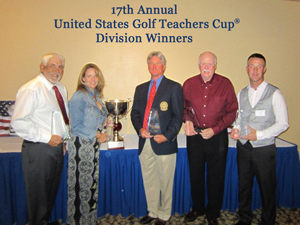
Finally, I’m looking forward to going to the US Golf Teachers Cup in Nevada. The competition is great and the people are even better. I hope to see you there.
Several factors contributed to the acceptance of golf back into the Games, the most important being golf’s increasing international appeal and popularity. There is no question that this is also another after-effect of Tiger Woods’ dominance, popularity, and international appeal. The recent push for golf back into the Games started during the height of Woods’ perch as the king of golf.
There is no question that golf is also more accepted as a sport. Golf has also been embraced by minorities more than ever. The players look and appear to the public to be more athletic, mostly again thanks to Woods, who looks and trains like an NFL wide receiver. One could argue that golf is much more of an athletic test than table tennis, for example. For many decades, golf was not considered a sport. It was considered by the public and the sports world as a game for overweight smokers who drank too much. Many tour players during the post-World War II era did nothing but enhance this image. Who can forget the videos of Hogan, Nicklaus, and Palmer smoking on TV while playing?
The Olympics’ huge success as a TV event and its immense popularity among the general public should do nothing but help the game. A lot of the impact will be decided by two things: How much coverage NBC devotes to golf and who participates. Of courses the anticipated ratings compared to other traditional Olympics events will be tough for NBC to judge. It would a big gamble to put golf on in prime time. More than likely it will have a devoted channel like basketball had for the London Games. As evidenced by the poor ratings for the Nationwide and LPGA Tours would suggest, unless the best male players in the world participate, the number of viewers might be small.
Judging by the competition to be the architect of the yet-to-be-built golf course, one would think that there will be great interest among golf’s elite to participate. Gil Hanse beat out a who’s who list of modern-day architects, including Jack Nicklaus. Hanse is an American architect from Pennsylvania.
The exact format to pick the players has also not been determined. The Olympics have been moving to professionals in all sports for many years, so it is a good bet that we will see the usual faces. If the recent comments of the game’s top players are any indication, there will be strong competition among the top 100 players worldwide to represent their country.
Some purists are calling for the International Olympic Committee to require countries to send pure amateurs. While the idea is admirable, it would greatly lessen the interest and the ratings success. The excitement generated, the TV ratings, and the smoothness of the operation will determine if golf will be extended into future Games. From strictly a big-splash standpoint, I think golf would be wise to include the world’s best players for at least the Rio Games. We need to hear the media and the public in general talking about golf when the Games are happening. The competition for attention is overwhelming. Gymnastics, swimming, track, and beach volleyball rule the modern Olympics. For golf to get some attention, we need the best players participating.
Hopefully, we will get more details for the format and the plan to pick players in 2013. While the format and players are up in the air, and the golf course not having been built yet being a big question mark, personally I think the importance of having golf return to the Olympics is not debatable. It can do nothing but help propel the game to even greater heights from an international standpoint.
An Olympic golf hero winning a medal may create new interest among his country’s youth. It should also continue to further the perception of golf as a real athletic sport. If international minority players do well, it can also create more interest for golf in third-world countries and further erode golf’s image as a rich white man’s game. All of that can be nothing but good for the game.