Online Certification Course – $495.00
This course — created by golf club managers who specialize in all subjects — trains and certifies golf club managers by offering instructional videos on every aspect of golf club management. This common-sense approach to learning is popular because so many of our participants already have a wealth of knowledge from other areas of life and business. These individuals do not require lengthy college courses or apprenticeship programs that generally last for years.
Golf Management can prove to be a very rewarding career. In the United States alone, there are 17,000 golf courses, and with golf becoming more of a global game, many certified golf club managers are finding employment outside of the United States as well. Additionally, current golf club managers are purchasing our material to refresh their knowledge on various subjects.
Our Educational Staff
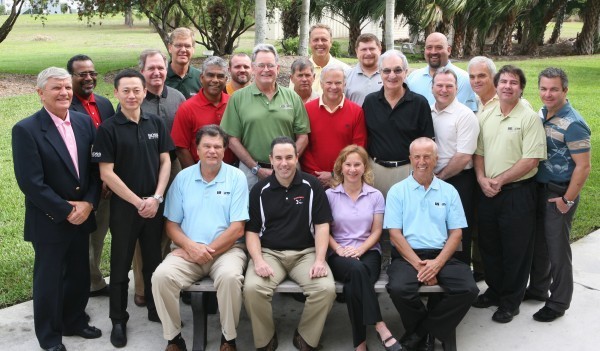
The USGTF has taken advantage of the incredible talent within our organization, and in doing so, we provide education through online video lessons from currently employed specialists in golf club management. Our colleagues are open and thoughtful people who share their personal knowledge and years of experience in golf management.
The Golf Management Industry
Golf management is a huge industry. There are over 35 thousand golf courses worldwide that all require competent, service-oriented individuals to manage facilities. Furthermore, golf management is not restricted to golf courses alone. Popular national and international golf resorts require well-trained individuals who understand the importance of profit and loss.
Just as important in their own right are golf teaching professionals. These people are the true ambassadors of the game, and their skills are essential to the growth of golf. They have the unique opportunity to mend a fragile ego or enhance a family vacation. In fact, many golf teaching professionals eventually enter into the field of golf management as a natural evolution through their performance, effort, and maturity.
Professional golf management is also the key to the thousands of golf retail stores throughout the world. Marketing skills, knowledge of product and display techniques, properly discounting and timely sales, certain computer skills, as well as the age-old art of selling, are required.
Further included in the industry are golf driving ranges, golf manufacturers and their representatives, the many golf trade shows, and the very lucrative golf travel industry. With regard to all of these segments of the 65 billion dollar golf industry, employers are more inclined to hire personable individuals with a professional golf management certification.
The following topics are covered in the online course
- Pro Shop Merchandising
- All About Agronomy
- All About Employee Theft
- Tracking Golf Club Revenue
- Customer Relations
- Policies and Procedures
- Managing a Golf Course on a Strict Budget
- Introduction to Accounting
- The Professional – A Collection of stories and anecdotes from the golf service industry to provoke thought and action
- The Quest for Excellence
This online course requires the successful completion of a 50-question, multiple-choice test

Certified Golf Club Manager® is a service mark of the United States Golf Teachers Federation and is our unique brand that represents the very best in golf club management. All those who become certified through our online program are permitted to use this service mark in promoting their golf careers.
How Blackjack Rules and Variants Evolved at Casizoids Canadian Tables
Blackjack has been a fixture of Canadian gambling culture for decades, but the specific rules and table configurations that players encounter today are the product of a long and layered regulatory history. From the early days of brick-and-mortar casinos in provinces like British Columbia and Ontario to the emergence of licensed online platforms in the 2010s, the game has undergone meaningful structural changes that reflect both consumer demand and the evolving priorities of gaming regulators. Understanding how these changes unfolded requires looking at the mechanics of the game itself, the provincial frameworks that govern it, and the ways operators have responded to competitive pressure from international markets.
The Foundation: Classic Blackjack Rules in Canadian Casinos
When provincial gaming authorities began licensing commercial casinos in the early 1990s — British Columbia Gaming opened River Rock’s predecessor operations in 1996, and Ontario’s Casino Windsor launched in 1994 — the blackjack tables largely followed a standardized North American ruleset. Dealers stood on soft 17, players could double down on any two cards, and splitting was permitted up to three hands. These rules were not arbitrary. They were calibrated to produce a house edge of approximately 0.5 percent under optimal basic strategy, a figure that regulators and operators considered commercially sustainable while remaining fair to informed players.
The number of decks in play became a significant variable early on. Single-deck and double-deck games were common in smaller venues and had been standard in Nevada-style play for years. However, Canadian provincial casinos moved relatively quickly toward six- and eight-deck shoe games through the late 1990s and early 2000s. The primary driver was card counting mitigation. High-profile incidents at Casino Niagara and several Lower Mainland venues in British Columbia — where teams of advantage players were identified using shuffle tracking and count-based betting systems — prompted floor managers and compliance teams to push for deeper shoe penetration and more frequent shuffles. By 2003, the majority of table games in major Canadian commercial casinos were dealt from six-deck shoes with penetration of roughly 65 to 75 percent before reshuffling.
Blackjack payouts also became a point of contention during this period. The traditional 3:2 payout on a natural blackjack had been the industry standard for most of the twentieth century. Some venues began experimenting with 6:5 payouts on single-deck games as a way to increase margins while marketing the lower deck count as an advantage to casual players who associated fewer decks with better odds. Consumer advocacy groups and gaming analysts criticized this practice sharply. A 6:5 payout increases the house edge by approximately 1.39 percentage points on its own, effectively turning a favorable game into a poor one regardless of deck count. Canadian regulators in several provinces were slower than Nevada’s Gaming Control Board to formally restrict these payout structures, leaving a period of inconsistency across different venues through the mid-2000s.
Regional Variation and Provincial Regulatory Divergence
One of the most distinctive features of Canadian blackjack history is the degree to which rules varied by province. Unlike the United States, where Nevada and New Jersey effectively set national standards through their market size and regulatory influence, Canada’s provincial gaming model produced genuine divergence. Quebec’s Loto-Québec operated its casino properties — Casino de Montréal, Casino du Lac-Leamy, and Casino de Mont-Tremblant — under rules that differed in subtle but meaningful ways from those in Ontario or Alberta. In Quebec, dealers were required to peek for blackjack when showing an ace, a rule known as the “hole card” game. In some western Canadian venues, no-hole-card rules were in effect for a period, which changes the optimal strategy for doubling and splitting against dealer tens and aces.
The Atlantic provinces presented yet another configuration. The Atlantic Lottery Corporation, which oversees gaming in New Brunswick, Nova Scotia, Prince Edward Island, and Newfoundland and Labrador, operated Casino Nova Scotia and Casino New Brunswick under rules that were generally more conservative in terms of player options. Surrender — both early and late — was rarely offered in Atlantic Canadian venues during the 2000s, even as it became more common in Ontario and British Columbia as a competitive differentiator. Late surrender, which allows a player to forfeit half their bet after the dealer checks for blackjack, reduces the house edge by roughly 0.07 to 0.09 percent depending on the specific ruleset, making it a meaningful concession to skilled players.
The online transition that began in earnest around 2010 to 2013 introduced a new layer of complexity. When the Kahnawake Gaming Commission, operating from the Mohawk Territory in Quebec, became a significant licensor for online gambling platforms serving Canadian players, it brought its own compliance standards that did not always align with provincial frameworks. This created a situation where players in Ontario might simultaneously have access to provincially regulated online tables through OLG.ca and offshore-licensed platforms with different rule configurations. The rules available at Casizoids, for instance, reflect the kind of multi-variant environment that emerged from this regulatory fragmentation, where operators needed to offer classic Vegas rules, European no-hole-card variants, and high-limit versions of the game to serve a diverse player base with different expectations and strategic backgrounds.
The Rise of Blackjack Variants and Side Bets
Beginning in the mid-2000s and accelerating through the 2010s, Canadian casino floors saw the introduction of a range of blackjack variants designed to increase revenue per table and attract players who found the base game too slow or insufficiently engaging. Blackjack Switch, developed by Geoff Hall and first introduced commercially around 2009, appeared in several Ontario and British Columbia venues within a few years of its debut. The game allows players to swap the top cards between two hands, which dramatically improves expected hand values — a concession offset by a rule requiring the dealer to push on 22 rather than bust, and by paying even money on natural blackjacks.
Perfect Pairs and 21+3 side bets became nearly ubiquitous on Canadian tables by 2012. These wagers, placed before the deal, pay based on the composition of the player’s initial two cards (in the case of Perfect Pairs) or the combination of the player’s two cards and the dealer’s upcard forming poker-style hands (in the case of 21+3). The house edges on these side bets are substantially higher than the base game — typically between 3.5 and 6 percent depending on the specific paytable — which is precisely why operators embraced them. From a regulatory standpoint, side bets required separate approval in most provinces, and the approval process helped standardize paytables to some degree, though variation still exists between venues.
Spanish 21, which uses a 48-card deck with all tens removed, arrived in Canadian casinos during the early 2000s and found a loyal following particularly in western Canada. The removal of tens significantly increases the house edge from the base game perspective, but Spanish 21 compensates with a generous set of player-favorable rules: players can double down after splitting, late surrender is always available, and there are bonus payouts for specific hand configurations such as a 6-7-8 or 7-7-7 combination. The net house edge under optimal Spanish 21 strategy is comparable to standard blackjack, but the game’s complexity means that many casual players face a higher effective edge than they would at a conventional table.
Online Platforms and Live Dealer Blackjack in the Canadian Market
The launch of iGaming Ontario in April 2022 represented the most significant structural shift in Canadian online blackjack since the early days of internet gambling. For the first time, a major Canadian province created a regulated, competitive online casino market where private operators could offer real-money games under the oversight of the Alcohol and Gaming Commission of Ontario (AGCO) and its market conduct standards. This framework required operators to use certified random number generators for digital blackjack, maintain specific return-to-player minimums, and clearly disclose all applicable rules to players before they wagered.
Live dealer blackjack, powered primarily by software from Evolution Gaming and Playtech, became a central offering in this regulated environment. These games are dealt by human dealers in studio settings and streamed in real time, combining the procedural transparency of a physical table with the accessibility of online play. The rules in live dealer games are explicitly stated in the game interface — deck count, dealer hit or stand on soft 17, available side bets, and payout structures are all disclosed before the first card is dealt. This transparency was a direct response to years of player complaints about rule ambiguity in earlier online blackjack products.
Infinite Blackjack, another Evolution Gaming product, gained particular traction in the Canadian market because it allows an unlimited number of players to participate in a single hand simultaneously, each making independent decisions. This addressed one of the practical limitations of live dealer games — seat availability — while maintaining the social and procedural elements that distinguish live play from purely digital variants. The house rules for Infinite Blackjack are fixed: dealer stands on soft 17, late surrender is available, and there are four side bet options with individually disclosed house edges. Canadian regulators have generally approved these configurations without modification, treating them as equivalent to physical table game offerings in terms of compliance requirements.
The trajectory of blackjack rules in Canadian casinos reflects a broader pattern in the gaming industry: initial standardization driven by regulatory efficiency, followed by deliberate diversification as operators sought competitive advantages, and then a gradual return to transparency requirements as consumer protection concerns gained regulatory traction. Players who understand this history are better positioned to evaluate the specific rules at any table they encounter — whether in a physical casino in Niagara Falls or Windsor, or on a licensed online platform operating under provincial oversight. The rule variations are not cosmetic; they have measurable effects on expected outcomes, and the differences between a 3:2 payout game with late surrender and a 6:5 game without it can amount to several percentage points of edge over a session of meaningful length.