


Editorial – How Much Do We And Our Students Rely On Our Equipment?
 By: Mark Harman, Director of Education
“I’m not good enough to get fitted for equipment” is the mantra of too many golfers who wish to save money in purchasing golf clubs. The fact is (and I confess to hearing this elsewhere), better players can often find a way to make ill-fitting equipment work while the average player can’t. In other words, the average player can’t afford not to have fitted clubs.
For me personally, I am very picky about my equipment as I can feel the minutest of differences. This comes from too many hours, days and years of trying to become a professional golfer back in the day, and my sense of feel was highly refined by this. Of course, properly fitted equipment can only take us so far. We and our students have to have a reliable-enough swing in order to make improvement and enjoy the game.
Basic things we can do as teaching professionals is to examine our student’s shaft flexes to see if they are a good fit. Although generally the slower the swing the more flexible the shaft should be, there are exceptions to this rule. The club must both feel good to the student and give him or her a reasonable belief they can develop a measure of consistency with it. This might lead to strange situations where someone with tour-like clubhead speed playing regular shafts and slow-swinging senior golfers playing stiff shafts. Such scenarios are rare but they do happen, so keep an open mind.
We can also check if the lie angles on the irons are correct by examining the divot patterns. Many golfers’ divots will be toe-deep, indicating a lie angle that is too flat and thereby promoting an open clubface at impact. If you teach indoors, a lie angle hitting board and some lie angle tape will do the trick. In closing, while properly fitted equipment is important, it is also only one part of the improvement and enjoyment equation.
By: Mark Harman, Director of Education
“I’m not good enough to get fitted for equipment” is the mantra of too many golfers who wish to save money in purchasing golf clubs. The fact is (and I confess to hearing this elsewhere), better players can often find a way to make ill-fitting equipment work while the average player can’t. In other words, the average player can’t afford not to have fitted clubs.
For me personally, I am very picky about my equipment as I can feel the minutest of differences. This comes from too many hours, days and years of trying to become a professional golfer back in the day, and my sense of feel was highly refined by this. Of course, properly fitted equipment can only take us so far. We and our students have to have a reliable-enough swing in order to make improvement and enjoy the game.
Basic things we can do as teaching professionals is to examine our student’s shaft flexes to see if they are a good fit. Although generally the slower the swing the more flexible the shaft should be, there are exceptions to this rule. The club must both feel good to the student and give him or her a reasonable belief they can develop a measure of consistency with it. This might lead to strange situations where someone with tour-like clubhead speed playing regular shafts and slow-swinging senior golfers playing stiff shafts. Such scenarios are rare but they do happen, so keep an open mind.
We can also check if the lie angles on the irons are correct by examining the divot patterns. Many golfers’ divots will be toe-deep, indicating a lie angle that is too flat and thereby promoting an open clubface at impact. If you teach indoors, a lie angle hitting board and some lie angle tape will do the trick. In closing, while properly fitted equipment is important, it is also only one part of the improvement and enjoyment equation.
 Longtime USGTF Partner, Budget Rental offer USGTF members and friends great savings and offers any time they travel – anywhere! Simply use the USGTF special BCD (Budget Customer Discount) number D815100 when reserving your car online.
Book today to start saving at
Longtime USGTF Partner, Budget Rental offer USGTF members and friends great savings and offers any time they travel – anywhere! Simply use the USGTF special BCD (Budget Customer Discount) number D815100 when reserving your car online.
Book today to start saving at 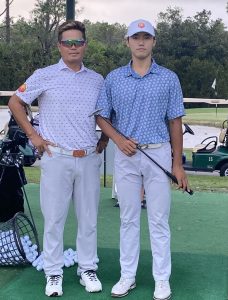 By Ken Kim, USGTF Master, Davenport, Florida
My golf academy (Team J.K., Inc.) has trained 47 established tour players currently all over the world since 2004. Jun Choi (Beomjun Choi) is a playing professional originally from South Korea. His main goal is to play professional golf on the PGA Tour.
Choi now travels all over the States in playing on the APT, FPG and GPro tours. Chio went to the Korn Ferry Q-School for the first time in 2022. He successfully passed the pre-qualifier in fourth place, shooting -12 for three rounds. He is currently based in Orlando, Florida.
He is coached by myself (PGA Professional and USGTF Master Golf Teaching Professional) and June Lee (LPGA Class A Professional). The main focus is on his swing, short game, putting and mental prep for tournaments.
Choi has increased his clubhead speed from 114 mph to 125 mph in three months, consistently hitting over 176 mph in ball speed. However, he also has great touch in his short game. He practiced relentlessly for hours in order to improve his skills and his understanding of fundamentals. His self-motivation and tenacity are what allowed him to get better every month, and not because of a set platform of training. It was his heart desiring more and his self-discipline to work for it. Often, we discuss biomechanics and how is it different from the kinesiology, or the advantages and disadvantages of a quantitative biomechanical analysis. Jun truly has an understanding of how things are working.
This kind of character is rare in today’s tour player, and I am confident it will benefit him on any professional tour, that includes the PGA, KPGA, or Korn Ferry tours. Choi will not become apathetic, but will unceasingly search to improve himself and keep moving forward to become a PGA Tour player.
By Ken Kim, USGTF Master, Davenport, Florida
My golf academy (Team J.K., Inc.) has trained 47 established tour players currently all over the world since 2004. Jun Choi (Beomjun Choi) is a playing professional originally from South Korea. His main goal is to play professional golf on the PGA Tour.
Choi now travels all over the States in playing on the APT, FPG and GPro tours. Chio went to the Korn Ferry Q-School for the first time in 2022. He successfully passed the pre-qualifier in fourth place, shooting -12 for three rounds. He is currently based in Orlando, Florida.
He is coached by myself (PGA Professional and USGTF Master Golf Teaching Professional) and June Lee (LPGA Class A Professional). The main focus is on his swing, short game, putting and mental prep for tournaments.
Choi has increased his clubhead speed from 114 mph to 125 mph in three months, consistently hitting over 176 mph in ball speed. However, he also has great touch in his short game. He practiced relentlessly for hours in order to improve his skills and his understanding of fundamentals. His self-motivation and tenacity are what allowed him to get better every month, and not because of a set platform of training. It was his heart desiring more and his self-discipline to work for it. Often, we discuss biomechanics and how is it different from the kinesiology, or the advantages and disadvantages of a quantitative biomechanical analysis. Jun truly has an understanding of how things are working.
This kind of character is rare in today’s tour player, and I am confident it will benefit him on any professional tour, that includes the PGA, KPGA, or Korn Ferry tours. Choi will not become apathetic, but will unceasingly search to improve himself and keep moving forward to become a PGA Tour player.
 By Ben Martin, USGTF Member, Trinidad
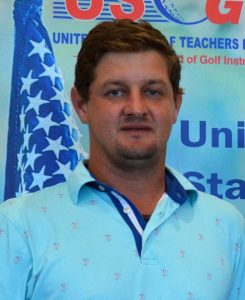
I got into golf at the age of 5. I grew up near the St Andrews golf club in Trinidad. My dad started me with one club and the rest is history. I have a deep-rooted love and passion for the game of golf. It is a big part of me and my life.
My main golf inspiration was Tiger Woods. He took the game to the next level and was amazing to see what he achieved in his career. The amount of records he set and broke sets him apart from the rest! Our local hero in Trinidad is Stephen Ames, who has also done a lot for myself over my teenage years. I will be forever thankful for the help I have received over the years.
I am a coach at St. Andrews Golf Club in Moka, Trinidad. I also play as often as I can because that is what gave me my love for this game. I hope to play in as many events in the future as I can. It was a pleasure coming to meet the USGTF crew, and even more of a pleasure to be the Open champion with a record-breaking score of -12 for two days.
(Editor’s note: At just 14, Martin represented Trinidad and Tobago on the men’s national team, being the youngest player ever selected. After having a very successful amateur golfing career in Trinidad and around the Caribbean, Martin went on to play in some of the biggest amateur events around the world in countries such as the United States, Canada, South Africa, Peru, Puerto Rico, England, Scotland and Spain in an attempt to further his golfing career. Martin has also won many professional championships, including being a six-time champion of his country’s national championship, the Trinidad and Tobago Open.)
By Ben Martin, USGTF Member, Trinidad
I got into golf at the age of 5. I grew up near the St Andrews golf club in Trinidad. My dad started me with one club and the rest is history. I have a deep-rooted love and passion for the game of golf. It is a big part of me and my life.
My main golf inspiration was Tiger Woods. He took the game to the next level and was amazing to see what he achieved in his career. The amount of records he set and broke sets him apart from the rest! Our local hero in Trinidad is Stephen Ames, who has also done a lot for myself over my teenage years. I will be forever thankful for the help I have received over the years.
I am a coach at St. Andrews Golf Club in Moka, Trinidad. I also play as often as I can because that is what gave me my love for this game. I hope to play in as many events in the future as I can. It was a pleasure coming to meet the USGTF crew, and even more of a pleasure to be the Open champion with a record-breaking score of -12 for two days.
(Editor’s note: At just 14, Martin represented Trinidad and Tobago on the men’s national team, being the youngest player ever selected. After having a very successful amateur golfing career in Trinidad and around the Caribbean, Martin went on to play in some of the biggest amateur events around the world in countries such as the United States, Canada, South Africa, Peru, Puerto Rico, England, Scotland and Spain in an attempt to further his golfing career. Martin has also won many professional championships, including being a six-time champion of his country’s national championship, the Trinidad and Tobago Open.)

 By Sachin Bhattarai, USGTF Member, Kathmandu, Nepal
During 2022, the game of golf has advanced significantly in Nepal. The ladies’ captain of our club organized the Nepal Women’s Open Golf Tournament for the first time this year. The competition has also boosted female golfers’ interest in the present day. Due to the event, I genuinely believe that we may find more female golfers in the next few days who will be competing in more matches and tournaments.
Not only are female golfers interested, but for the first time our academy has also begun offering regular golf lessons where nearly 120 students are interested in the sport and want to develop their golf knowledge. Similar to that, the scramble junior golf competition was also arranged by the club president of Royal Nepal Golf Club this year, and the junior event’s competitors displayed a great deal of enthusiasm. I want to create more teaching professionals and new golfers in the upcoming days. I will do my best to train Nepalese golfers and strive to turn them into teaching professionals there, much like how the USGTF taught golf teachers around the world and made them teaching professionals.
By Sachin Bhattarai, USGTF Member, Kathmandu, Nepal
During 2022, the game of golf has advanced significantly in Nepal. The ladies’ captain of our club organized the Nepal Women’s Open Golf Tournament for the first time this year. The competition has also boosted female golfers’ interest in the present day. Due to the event, I genuinely believe that we may find more female golfers in the next few days who will be competing in more matches and tournaments.
Not only are female golfers interested, but for the first time our academy has also begun offering regular golf lessons where nearly 120 students are interested in the sport and want to develop their golf knowledge. Similar to that, the scramble junior golf competition was also arranged by the club president of Royal Nepal Golf Club this year, and the junior event’s competitors displayed a great deal of enthusiasm. I want to create more teaching professionals and new golfers in the upcoming days. I will do my best to train Nepalese golfers and strive to turn them into teaching professionals there, much like how the USGTF taught golf teachers around the world and made them teaching professionals.

 By: Mark Harman, Director of Education
Would Harry Vardon recognize today’s game if he could be magically transported to 2022? While some things would be the same, others would be so vastly different that Vardon might well wonder if it’s even the same game.
Things used to change slowly in golf, but with the dawn of the 21st century, things are picking up at a rapid pace. Where once new technology took years to embrace, today’s players and coaches are quick to adopt a change if it is demonstrated to be beneficial. You would be hard-pressed to find a modern tour player who does not have a TrackMan or GC Quad – or in many cases both – to analyze their ball flight and club data to the nth degree. Experts in analytics crunch the data and lay out very specifically where players need to improve. Training regimens continue to evolve as the latest research comes in.
The game of professional golf was shaken up in 2022 by the advent of the LIV Tour. Whether this tour can survive without a visible means of revenue remains to be seen. In response, the PGA Tour upped the purses dramatically for its marquee events and obtained pledges from its top players to play more golf. A tournament purse of $25 million would have been unthinkable just a few short years ago…and imagine what Vardon would think! But do not be surprised if, within the next decade, a tournament purse of $100 million is offered. So, it seems the game of professional golf, at least on the men’s side, will continue to see escalating purses.
When it comes to teaching, almost certainly within the next decade every full-time teacher will have much of the latest technology available. There will still be teachers who go to the lesson tee with nothing more than their smartphone to take video, but they will usually be the club pro or someone who gives lessons only occasionally.
Finally, the USGA and R&A have made a big deal about reigning in distance, or at least preventing future increases. Their problem is that today’s professional golfer is a true athlete who trains and is larger and much stronger than their counterparts of yesteryear. Whereas Dan Pohl led the PGA Tour in driving distance in 1980 with an average of 274.3 yards using a persimmon driver and balata balls, today’s longest players would probably still approach a 300-yard average with such implements. All indications are that the USGA and R&A will finally adopt one set of equipment rules for the pro game and elite amateur competitions and one for play at the club level.
By: Mark Harman, Director of Education
Would Harry Vardon recognize today’s game if he could be magically transported to 2022? While some things would be the same, others would be so vastly different that Vardon might well wonder if it’s even the same game.
Things used to change slowly in golf, but with the dawn of the 21st century, things are picking up at a rapid pace. Where once new technology took years to embrace, today’s players and coaches are quick to adopt a change if it is demonstrated to be beneficial. You would be hard-pressed to find a modern tour player who does not have a TrackMan or GC Quad – or in many cases both – to analyze their ball flight and club data to the nth degree. Experts in analytics crunch the data and lay out very specifically where players need to improve. Training regimens continue to evolve as the latest research comes in.
The game of professional golf was shaken up in 2022 by the advent of the LIV Tour. Whether this tour can survive without a visible means of revenue remains to be seen. In response, the PGA Tour upped the purses dramatically for its marquee events and obtained pledges from its top players to play more golf. A tournament purse of $25 million would have been unthinkable just a few short years ago…and imagine what Vardon would think! But do not be surprised if, within the next decade, a tournament purse of $100 million is offered. So, it seems the game of professional golf, at least on the men’s side, will continue to see escalating purses.
When it comes to teaching, almost certainly within the next decade every full-time teacher will have much of the latest technology available. There will still be teachers who go to the lesson tee with nothing more than their smartphone to take video, but they will usually be the club pro or someone who gives lessons only occasionally.
Finally, the USGA and R&A have made a big deal about reigning in distance, or at least preventing future increases. Their problem is that today’s professional golfer is a true athlete who trains and is larger and much stronger than their counterparts of yesteryear. Whereas Dan Pohl led the PGA Tour in driving distance in 1980 with an average of 274.3 yards using a persimmon driver and balata balls, today’s longest players would probably still approach a 300-yard average with such implements. All indications are that the USGA and R&A will finally adopt one set of equipment rules for the pro game and elite amateur competitions and one for play at the club level.