



By Jill J. Johnson, USGTF Contributing Writer Minneapolis, Minnesota

The golf industry has been working hard on ways to grow the game. As the founder of the first international values-based junior golf camps in the 1970s, Dr. Gary Wiren gives this advice:
“The biggest problem we face is reaching prospective players in non-traditional settings. Plenty of people want to learn to play golf. The key is keeping the instruction simple while ensuring success. Make it fun and they will come – that philosophy works at any age.” – Dr. Gary Wiren
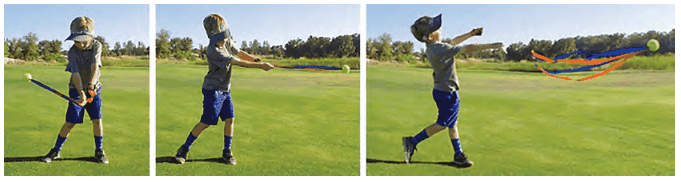 The points made by Dr. Wiren are, first, don’t go to a golf course or driving range to recruit new golfers; they are already there. Move away from the course to reach players in non-golf settings, namely schools, churches, city parks, community centers, senior care facilities, YMCAs, etc. Secondly, technical jargon should be replaced with simple instructions that allow the player to see, feel and understand the game. Lastly, keep it fun. Golf is a game wherever it is played.
 If you had to pick one indispensable tool to teach the game, what would it be? As the general manager of a company whose mission is to work with teachers to find the most useful teaching products, I can shed some light on what products are proving their worth on the lesson tee. Below are three groups of products: perennial favorites, what’s hot now, and the most useful kits for teaching beginners. After all, growing the game not only means recruiting new players, but keeping the ones you have happy. Everyone wants to improve their game!
Here are the 10 top aids that have been on the market for more than 5 years. There are hundreds that are useful, but these are the top of the charts: Swingyde, Orange Whip, Impact Bag, eGolfRing, Impact Ball, Alignment Rods, Impact SNAP, Putting Alignment Mirror, Putting Arc T3, Power Fan.
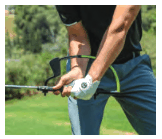 Next, let’s look at 10 products you don’t want to miss that have come to the aid of the golf world more recently. Consider this a recommended reading list for your next lesson plan. Some are great visual aids, others measure speed or precision, while some will make your life as a teacher a little easier: The Hanger, Chip Tac Toe, Acu-Strike Mat, SmartBall, PuttOUT Pressure Trainer, SuperSpeed Sets, Perfect Practice Putting Mat, Strike Spray, Colour Path Golf System, Total Golf Trainer.
But the question remains, what is the best way to start someone off right? How do you teach a person golf where traditional golf may not even be allowed? What is the best “first touch” golf system?
The answer is Wally Armstrong’s Go Start Golf kit. Wally is a USGTF member and lifetime Tour member who has invested over 30 years bringing our great game, with safe equipment and fun teaching methods, to first-time players of all ages and abilities around the world in every setting imaginable.
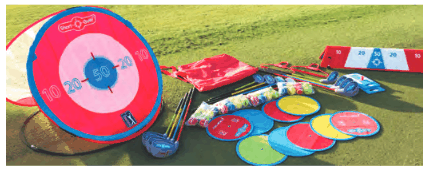 The coaching kit provides his AirGolfFlyers, which teach the game of golf and a feeling for the four shots of golf, all while playing. Wally calls this his Play-To-Learn golf method. Participants learn the rules of golf and the terminology as they’re developing their swing feelings. There are many fun games that can be played indoors or outdoors using AirGolf. Once these basic swing, distance and direction skills are acquired, the student transitions into ShortGolf. ShortGolf provides safe and fun First Touch equipment that you can utilize in your lesson plans to get them hooked and grow the game.
Moving away from the golf course and using a proven First Touch training system that can be used anywhere and will bring more players to the game. Keeping your lessons fun and focused will keep them playing for life.
Dane Wiren is general manager and John Leighton is customer relations manager for www.GolfTrainingAids.com. Founded in 1984, the company offers the largest selection of teaching aids in the world. Discounts are provided to USGTF members.
I’ll cut straight to the point by stating one simple fact: Your business needs a “healthy” social media presence.
Having a social media presence has reached the level where it is “expected”. If people search for you or your business and you don’t have a “healthy” presence on social media they often move on to the next business that does. A healthy and viable social media presence should be an essential element of your marketing strategy.
There is never a “wrong time” to start building a social media presence. With that being said it is vital that your presence reflects yourself and your business in a professional manner. This is especially important in the golf industry (I’ll address this specific topic in an upcoming article).
A consistent and viable Social Media Strategy can drive credibility and growth for yourself and your business by building relationships with your customers and prospects.
Five ways a Social Media Presence can benefit your Golf Business
Increased visibility and awareness of your brand
Through a consistent and relevant social media presence targeting your “niche” and region will ultimately increase awareness of your “brand” of services and/or products!
Build engagement with customers and prospects while taking customer service to a higher level
Social Media provides an effective platform to engage with your customers and prospects by offering online support.
Build authority for yourself & your business within the Golf community
Today’s customers have become more discerning when making the decision as to which businesses they choose to patronize and support. More often than not they will look for you and/or your business online. They will have an expectation of finding a professional, functional and up to date website. In addition they will be looking for your Facebook Business Page as well as other social media platforms such as LinkedIn, Twitter, Instagram or Pinterest. This provides you with the perfect opportunity to establish yourself as an “authority” in your niche. Be it as a golf teacher, golf coach or in the golf merchandise business. This is your opportunity to outshine your competition.
Social Media Marketing is less expensive than traditional advertising
Let’s face it, conventional marketing (TV, Radio, Print Ads, direct mailing…) can be very expensive and not every business (especially small businesses) can afford huge campaigns. With social media advertising you can get a lot of value for your dollar. This provides an excellent and affordable opportunity to grow your audience. Using social media advertising platforms such as Facebook and/or Instagram you have the ability to reach out to a very specific and targeted market. If you make use of no other social media platform I highly recommend that you at the very least have a viable/active Facebook “business page” presence. I must emphasize that the “business page” presence is not the same as having your own personal Facebook. All posts/content on the business page need to be relative to your business or industry. This is not the place to be posting photos of you and your buddies Saturday night venture to the brew pub (I will address post content in an upcoming article).
Facebook is one of the most popular social media platforms among adults in the United States. According to Pew Research Center surveys conducted in 2018 around two-thirds of U.S. adults (68%) actively use Facebook. By using the Facebook marketing platform you can target your advertising by region, sex, age, profession and interests. This is one of several means in which you can reach out to a large targeted audience within your geographic region.
Although it isn’t necessary to used paid social advertising to build your brand and find new customers it is by far the fastest means to do so. You always have the option of making full use of the appropriate platforms without the use of paid ads. This can work well if you happen to be someone that already has a personal social presence with a significant following. You can simple invite your current friends/followers to follow your new platforms and start building from there. This is a great approach to use to get started even if you plan to develop a paid advertising campaign.
Note: This is the first in a series of Social Media Marketing articles. Be sure and click on one or more of the Social Media Icons at the top right of the page to follow us on your favorite social platform. I monitor all of the USGTF social platforms and will be posting additional articles through those channels. If you have any questions in regard to social media marketing feel free to contact me either through USGTF social channels or directly via my email: weaverentp@gmail.com
If you’ve found this information to be helpful please take a moment and click on one of the Social Share buttons below.
 There’s an old saying, “The more things change, the more things stay the same.” That applies to the golf industry somewhat, but no one can doubt the seismic changes the golf landscape has seen in the past 30 years.
This year, 2019, marks the 30th anniversary of the founding of the United States Golf Teachers Federation. But when we think back to the beginning of 1989, things were markedly different, not only in the golf industry as a whole but also specifically in the golf teaching industry.
Golf schools thrived. Nationally recognized schools such as Golf Digest, Roland Stafford, Craft-Zavichas, Ben Sutton, Mt. Snow, United States Golf Academy, and of course, The Florida Golf School and the Illinois Golf School were attended annually by thousands of students from everywhere. The latter two were owned and operated by Geoff Bryant, who was able to successfully enter the golf school industry in the early 1980s with locations such as Club Med Sandpiper in Port St. Lucie, Florida, and Rolling Hills Country Club just down the road in Fort Lauderdale. With the success of those early locations, The Florida Golf School soon expanded to other destinations such as Daytona Beach, Clearwater, Lehigh Acres and Pompano Beach. Summer sessions were held at the Eagle Ridge Resort in Galena, Illinois.
Golf in 1989 was different than what it is in 2019. Wooden-headed drivers were still the norm and balata golf balls were played by tour players. Metal spikes still click-clacked on cart paths, and the back tees at most courses topped out at around 6,800 yards. Greg Norman, Nick Faldo, Seve Ballesteros and Curtis Strange ruled the professional game with drives that averaged in the 260s-range. Going for a par-5 in two shots was a big deal, and most of the time a fairway wood was required. Greens at tour events usually read around 9.5 on the Stimpmeter, and major championship events featured greens that rolled at a lighting pace, 11 or so. Pebble Beach could still be played for around $150, and premium golf balls cost around $2 per ball or $24 per dozen.
Getting back to the teaching industry, while golf schools were thriving, local professionals were doling out individual lessons, but most of the time students were getting a teacher who had not been properly trained – if he was even trained at all. And note that the use of the pronoun “he” is not an accident in that last sentence. Women professionals were few and far between unless they belonged to the LPGA. The system back then was that the head professional was supposed to help his assistants learn to teach, but in fact most would-be professionals were tossed out on the lesson tee and expected to figure it out for themselves.
In this backdrop, Bryant had a difficult time finding the qualified and personable teachers that he sought. So in 1989, he ran an ad in Golf Digest that said, “Learn to teach golf. The profession of a lifetime.” In September of that year, 12 candidates showed up at Lehigh Acres to learn the craft of teaching the game, and in January 1990 over 40 came. This signaled an historic sea change in the way the golf teaching industry would conduct itself, and golf teacher training and education would never be the same.
Those early classes featured a multitude of examiners with a wide array of teaching experience, imparting their wisdom to their charges. In turn, the newly-minted members returned home and successfully started their own teaching businesses. This change was so profound that at a PGA of America national meeting in the early 1990s, they realized that the USGTF had usurped its position as the “leader in the field of golf instruction,” and changed the way its members were certified as a direct result.
The dawn of the internet age in the late 1990s and early 2000s meant that online learning was taking place at colleges and universities, and the USGTF soon expanded into this area when it began offering Associate Member courses through online training. Looking into the future, plans are in the works to offer webinar-based certification classes and the ability of USGTF Master Teaching Professionals to certify members at their home facilities.
Golf itself today would be unrecognizable in many ways to golfers back in 1989. Small wooden-headed drivers have been replaced by 460cc titanium and composite drivers; metal spikes replaced by state-of-the-art plastic spikes that actually offer better traction; balata balls replaced by multi-material rocket-ship golf balls; par-5 snow routinely reached in two by professionals, and greens that Stimpmeter at 10-11 for everyday play at most top-end facilities. Rules are different in 2019, including taking drops from knee-height and leaving the flagstick in the hole while putting.
But even with these changes, some things do remain the same. Players of every ability want to improve. The challenge of getting a 1.68” ball into a 4 ¼” hole remains the same, even if the color of the ball is not always white anymore. Getting out into the fresh air and sunshine with friends is still sought after, even if occasionally a few times during the round one or more of the foursome have to check their smart phones.
But most of all, golf remains the enjoyable challenge that it has always been. And that part is sure to remain a constant for as long as the game is played.
Our 25 years of research has yielded the following: In summary, we are able to do simple body measurements, provide a student with stance widths that recruit different “core regions, “and match stance widths, posture and grip to their playing core region for maximum power and consistency. There are three ways to swing a golf club. These swings come out of one of our three core regions.
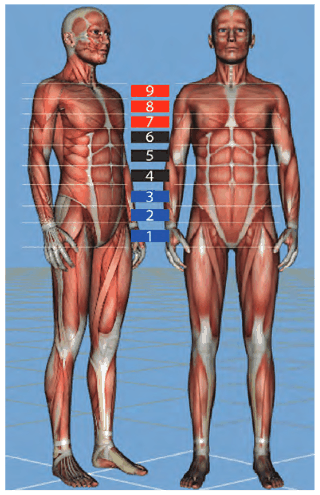
The following is an illustration of nine core regions that are identified by a printout from the results of the measurements of stance widths that recruit precise core regions. Each core region has different stance widths, posture, grip and swing characteristics.
The nine core regions within three main core regions
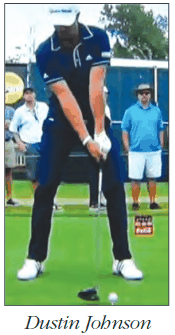 Upper Core Swing
The upper core players “test” for greater strength in their upper body and their trail arm will only “seat” at the side of the rib cage when tested, much less than the lower core player. The upper core player is unable to seat their trail arm inside their hip in the downswing. Their trail elbow is outside the trail hip on their side. Upper core players are arms and hands swingers. Their weak grip and grip position produce the least shaft lean and the least trail shoulder tilt at address of all the players.
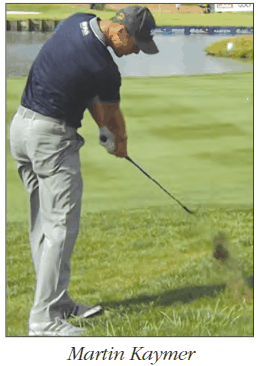 The upper core player’s balance is over the balls of their feet at address and through the swing. This is an important point we will revisit. Again, note that the upper core player’s balance is over the balls of their feet. The upper core player gets their power from the ground using torque (rotational) and vertical ground force. The upper core player has very little, if any, linear/horizontal motion in their golf swing as they load to their target side with a big trail hip turn, elbow out and on top position at the top of their backswing.
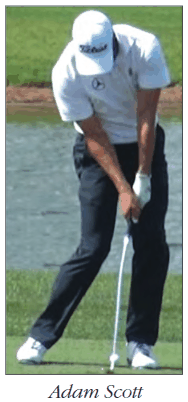 In the downswing, the middle core players begin with a rotation of their hips, and their shoulders, arms and hands follow, just the opposite sequence of the backswing. The downswing shaft plane crosses the middle core and the butt of the club points at the middle core at impact. The trail elbow is seated at the trail hip in the downswing. The hips are 45 to 60 percent cleared at impact and the delivery to the ball is on the side with a release 45 degrees (diagonally) to the target line.
What’s the big whoop about new and simplified rules? I guess it’s human nature to resist change, but anything to speed up play is good, in my opinion. I just wonder why it took so long to get these implemented. The process began back in 2012. Remember the Nike ad – “Just Do It.” Heck, if you’re the so-called ruling body, you should be able to make whatever changes are in the best interest of the game. There were originally 13 basic rules, and except for the one saying you must tee off within one clublength from the hole, they served the game well for hundreds of years. Now, there will be 24, down from 34. They’re going in the right direction.
But here is the real rub: 90 percent of golfers don’t play strictly by the rules, anyway. Yes, rules are important. As Kramer once said, “Without rules, there would be chaos.” For tournament play, absolutely! The average golfer is just out for a day with their buddies. I play with a group of guys once a week. Even after a half-hour on the driving range, they all hit two balls off the first tee. It’s commonplace to improve their lie or take a drop for lost balls and O.B. shots instead of going back to replay. Guess what? They use their illegitimate handicaps each week and no one complains about rule breaking in the $5 skins game. So, if I were the King of Golf, the last page of my rule book would say, “These rules are for tournament play. For all other forms of recreational play – do as you please.”