

Teaching Special Olympics Golf

Teaching Special Olympics Golf

Written By: Lee Koukes USGTF Member, Chatsworth, CA About two years ago, I became acquainted with a little girl and her grandfather. They had been on the driving range many times and I was aware that the little girl had a handicap. The grandfather was so dedicated and the little girl so determined, that I stopped to see if I could be of any help. Amber had no use of her right hand and arm, and even though she was swinging with her left hand and arm, she was still using a right-handed person’s stance. We tried a few things, and it soon became apparent that she had pretty good control using her left hand and arm, but using the left-handed person’s stance. Right then, I decided that I wanted to work with this little girl even more. After a couple of weeks, I got her a new set of golf clubs that I had specially made and tailored for her capabilities. I gave her lessons every Monday afternoon for several months and the results and progress were amazing. Her grandfather and I took her out on the course one day to play a few holes and we couldn’t believe what we were witnessing. While she could only hit the ball 15 to 20 yards or so, she was right in the fairway every time. She was sinking putts that even I had trouble with. What a transformation! I learned that Amber was involved in Special Olympics Gymnastics. Being a curious person by nature, I decided to inquire around and see if there were any Special Olympics for golf. After several phone calls to various areas, I finally was put in touch with a local chapter in Ventura County, California and called to see how I might get Amber qualified to play in some tournaments in the area or if they even had anything organized. I was told that there were a number of people with various handicaps who would like to learn to play golf but there just wasn’t anyone who could teach them. I told them what I had been doing with Amber and let them know that I would certainly be interested in working with them to start a golf program locally. Since they did not have a formal program organized, I spoke with my General Manager, who was very supportive of the idea and offered to give us the use of the driving range, golf carts when we went out to play a few holes, free golf balls, etc. We have a group of 12 athletes who range in age from 11 to 28. We have a tremendous amount of fun and all of this has been observed by others who have generously come forward and volunteered to assist with these fine young athletes. The volunteers are not only former and present students of mine, but golfers who have observed and heard of what we have been doing and wanted to get involved. I am especially proud of the teenagers who have been my students and are on the high school golf team – they have volunteered to give something back to the community and really look forward to coming out on Thursday evenings to help with our Special Olympics Team. My ultimate goal is to have my Special Olympic Golfers practice at UCLA one day, where a big Special Olympics Event takes place every June. I cannot begin to tell you what a rewarding experience this has been for me, when I look at the progress that each of the athletes has been able to achieve and I see that look of accomplishment and satisfaction on their faces, along with the joy their parents have voiced. It really makes me feel very fortunate to be a part of this. Maybe in a very small way, I really am making a difference. Many thanks to the USGTF. Without the excellent training I received, I would not have had the confidence to undertake this task. If you have any questions and would like to start a program like this in your area, please send me an email or fax so I can get in touch with you. It can be frustrating at times, but the rewards far outweigh the challenges. My fax number is 818-885-6044, or you can e-mail me at CandLinLA@aol.com.
Teaching the Mentally Challenged

Teaching the Mentally Challenged

By: Pat Church, USGTF Level IV Member Eugene, Oregon During my experiences with the Special Olympics golf team the biggest lesson learned has been PATIENCE!!! Many of the golfers have mental, as well as physical disabilities, so constant repetition is a key to their success and sometimes testing our patience. The practice sessions I use for Special Olympics’ golfers, closely mimic what they will face in their regional & state competitions, thus providing a level of comfort and confidence to them. In the case of many of the Special Olympic golfers I have trained, the golf swing has been secondary to the fact that I am giving them a chance to have a new experience. I would assume that if a once physically abled golfer becomes disabled, we would be providing the chance to enjoy their “freedom” again. Perhaps the greatest experience in working with mentally challenged golfers can be the simple joy to their reactions……..sinking a 5 foot putt, hitting a straight shot or just hitting the ball can be the cause for great jubilation! I strongly recommend to all my fellow teachers – Volunteer some time to the Special Olympics’ program in your area. The things learned with this group will make you a better teacher and your reward will be long lasting!

Teaching the Paraplegic

PARALYZED PEOPLE CAN PLAY GOLF!

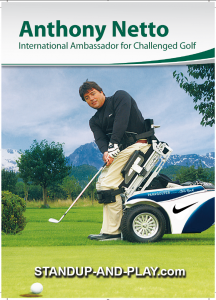
Anthony-Netto-Ambassador-216x300At one time, Anthony Netto was a professional golfer in South Africa with all the physical ability in the world.  In 1994, that reality changed drastically with an automobile accident that left Anthony paralyzed from the waist down.  He spent many months after the accident involved in grueling rehabilitation.  Determined not to give up on life and not content with confinement in a sitting position, Anthony began working with a team of engineers to design and develop a vehicle that would enable and help him to stand and play golf again.
Anthony founded the Stand Up And Play Foundation, which aims to ensure that every state in the USA has at least five such vehicles, or ParaMobiles, available as therapeutic tools and to allow persons who are wheelchair-bound to enjoy the chance to stand up and play.  A training workshop has been developed for medical professionals, golf coaches, and rehabilitation centers that enables them to work together and provide a service to those in need.
For more information on the Stand Up And Play Foundation, please email info@standup-and-play.com.
Group Lessons

Group Lessons

Recently, I was contacted by a woman who wanted to take a series of lessons with two of her friends. She stated she felt more comfortable being around her friends while trying to learn how to play golf. This comment made me ask her to elaborate on her feelings. She continued on, saying she would be embarrassed to take a one-on-one lesson, and that it would be less intimidating to have some of her friends join her. This conversation made me think a lot about how I market my lessons and if I was missing out on something. Over the next few weeks, I spoke with some friends about group lessons, and to my surprise, many said they would like to take lessons in a group setting. Some of the reasons they gave were being embarrassed in a one-on-one situation, less cost, and being in a less serious environment if with friends. To me, I was really excited to market lessons to this niche, helping others learn the sport who might otherwise not even consider individual lessons. By adding a few group lessons a week, I was still keeping my hourly rate where I wanted it to be, but also illustrated to other patrons on the course that there were different avenues to taking lessons. As golf teaching professionals, we need to step away and think about some of the fears held by our students. Most of us are friendly and easy to talk to, so we might take for granted that some people are just nervous having a professional observe them and possibly criticize their movements. Try to set up a few group lessons and make them fun; you will be surprised how much success it will bring you.
FedEx Cup still doesn’t have an identity – here’s how it can get one

FedEx Cup still doesn’t have an identity – here’s how it can get one

The FedEx Cup has an identity crisis, in my opinion. Here we are, eight years into it, and I still haven’t figured out what it’s supposed to represent. Player of the year? No, that’s done by a vote. Leading money winner? No, the $10 million that goes to the winner is considered bonus money, not official prize money. A season-long reward, as it was originally advertised? No, someone can come out of nowhere and get hot and win. A reward for playing the best in the playoffs? No, because a player can win the first three playoff events, finish second at the Tour Championship, and not win the trophy. So, what is the FedEx Cup? My idea helps to give it a bit of an identity, and here it is. First, let’s simplify this thing so it’s easy to follow, instead of using a complicated points system. Re-set everyone at zero points, just like all other sports do. Next, 125 players at the first playoff event, the Barclay’s, are far too many. Let’s cut that down to 75. That represents about the average number of players who make the cut each week, and allows everyone to play all four rounds. Let the top 60 and ties at the Barclay’s move on to the Deutsche Bank; top 45 and ties from there move on to the BMW; and the top 30 and ties move on to the Tour Championship. The only exceptions are that the regular season points leader (this year it was Rory McIlroy) and all playoff winners automatically qualify for all playoff events, including the Tour Championship. My system prevents everyone else from skipping a playoff event and still getting to play the following week. Finally, the winner of the Tour Championship should be the FedEx Cup champion, and make the $10 million official prize money, so the winner of the FedEx Cup also has the honor of being the leading money winner. I believe my idea would vastly improve what the FedEx Cup is now. What do you think?
Group Lessons

Group Lessons

Recently, I was contacted by a woman who wanted to take a series of lessons with two of her friends. She stated she felt more comfortable being around her friends while trying to learn how to play golf. This comment made me ask her to elaborate on her feelings. She continued on, saying she would be embarrassed to take a one-on-one lesson, and that it would be less intimidating to have some of her friends join her. This conversation made me think a lot about how I market my lessons and if I was missing out on something. Over the next few weeks, I spoke with some friends about group lessons, and to my surprise, many said they would like to take lessons in a group setting. Some of the reasons they gave were being embarrassed in a one-on-one situation, less cost, and being in a less serious environment if with friends. To me, I was really excited to market lessons to this niche, helping others learn the sport who might otherwise not even consider individual lessons. By adding a few group lessons a week, I was still keeping my hourly rate where I wanted it to be, but also illustrated to other patrons on the course that there were different avenues to taking lessons. As golf teaching professionals, we need to step away and think about some of the fears held by our students. Most of us are friendly and easy to talk to, so we might take for granted that some people are just nervous having a professional observe them and possibly criticize their movements. Try to set up a few group lessons and make them fun; you will be surprised how much success it will bring you.
Time to stop ignoring the game’s heritage

Time to stop ignoring the game’s heritage

As I was watching the Open from Royal Liverpool, a graphic came on the screen showing all the Championship winners at that venue going back to 1897. They were some of the giants of the game: Hagen, Hilton, Jones, Taylor, Thompson, and De Vincenzo, just to name a few. Then the commentator for the American broadcast said the following: “And for golfers in the United States, the only familiar name in the group is Tiger Woods.” The two professional golfers in the booth said nothing. I, on the other hand, would have said something like, “Come on, give the American golfer a little more credit than that for historical knowledge.” Then again, very little effort goes into presenting the historical perspective on a golf broadcast these days. It is sad, really, that a game as old and steeped in tradition as golf has just about abandoned its past. I can be watching a baseball game, and if something out of the ordinary happens, immediately the crew will have details about the last time a play like that occurred, even if it was 100 years ago. I have often wondered why golf is not like that. A few years back, I wrote a column for Golf Teaching Pro magazine titled, “Don’t just teach golf, teach history, too.” Maybe golf history is not that important on the grand scale of life. But, regardless of the subject, history is relevant to our understanding of other people and ourselves. There are valuable lessons to be learned from the actions of our forbearers. Growing up, I devoured books about the past. When the subject was golf, I learned about honesty from Bobby Jones and competitiveness from Walter Hagen. In a word, history taught me values. Too bad golf pays so little attention to it today. On the same broadcast, they joked that Bubba Watson had no idea who the Beatles were. Is that something to be proud of? I grew up with the group, but I also know Louie Armstrong, Sinatra, Jolson, and Goodman. That’s because in my time, people thought the past should be remembered. I just wish more people in golf today felt the same way.  
Look at the hole

Look at the hole

Anyone watching this year’s Masters tournament heard the commentators talk about Jordan Spieth’s unusual putting routine of looking at the hole while putting shorter putts inside five feet. He would go through his pre-shot routine, and right before starting his putting stroke, he would look at the hole. Why? If a player is having a problem releasing the putter or accelerating through the putt, this is a great way to help with that. With your eyes focused on the hole, it is natural for your hands to swing freely towards the target. With the green speeds at Augusta National, it is understandable why someone would be timid with their putting stroke. Jordan must have felt he was not putting freely enough to do this during the last few rounds of the tournament when he was in contention. Most of us have seen our students decelerate their putting stroke or stop the putter at impact. By having them set up and look at the hole, they will learn the proper sensation of accelerating the putter through the entire stroke. At first, when you have them try this drill, they will often hit the putt harder than normal; this is due to proper release and more acceleration. I hope this will help with your students’ putting strokes. It has helped with mine. My youngest daughter was struggling on her distance control on her putts this summer. I had her start looking at the hole every time. By doing so, the putter was allowed to have a more consistent swing and rhythm to the stroke. Her speed improved and she made more shots, thus increasing her confidence. As we all know, confidence is key to doing well at anything.
Bad Shots

Bad Shots

Bad shots are part of the game of golf; we all hit them.  After hitting a bad shot, there are different options on what happens next:  We can lose our temper while trying to hit a hero shot, or we can stay composed and hit a good shot to get us out of trouble.  I have found that one of the things separating great players from the rest of the field is they never follow a bad shot with another bad shot. Many times, watching the PGA Tour on TV, you will hear the announcer talk about a “comeback birdie.”  This is in reference to the player scoring a birdie after having a bogey or worse on the hole before.  Competitive golf is a lot about momentum.  Executing a good shot after a bad shot helps you keep a positive attitude. As teaching professionals, we need to teach our students how to keep the wheels from falling off once they hit a bad shot or have a bad hole.  Some of this is about teaching how to hit proper recovery shots, and the other is about maintaining a positive attitude when things go south.  One great way to teach these skills is to go on the course with your students for playing lessons.  It allows you to see how they handle bad situations and what recovery shots they need to learn.  In addition, it provides you with an opportunity to get out on the course and play a little golf yourself!
Helping your business by helping your student

Helping your business by helping your student

One of the things that fascinates me the most about the golf business, and there is a lot, is that even golf teachers and golf professionals don’t understand the avenues available through the big name original equipment manufacturers to acquire the correct equipment without buying thousands of dollars of poorly matched equipment. It is an established fact that, through years of research by many different research firms, that the average golf consumer has a ”golf budget”:  greens fees, lessons, and equipment. Golf teaching professionals that do not help their students get the right equipment are unwittingly hurting their own business. How? Very simple. When the average golfer buys a mass-produced golf club that doesn’t work with their swing and ball flight, they are wasting a good chunk of their golf budget. Once again, through research, we know that these “off-the-rack golfers” don’t take that many lessons. So, the answer is very simple, and most long-term teachers know this. If they don’t buy the right equipment, they buy more clubs. Hooray for the massive corporations; bad news for the teaching professional. That fourth driver in the last year that Joe Golfer bought could have been spent on instruction. Now, not everyone would spend that on lessons, but a surprising majority would. Personally, I can tell you honestly there were hundreds of times over the years students would pay for a series a lessons after a club fitting session with me, relieved at finding the correct equipment and the specs that worked with their swing and ball flight. They spent that extra golf money with ME! Not for the third set of irons in six months at the mammoth golf retail store. It’s the same as you may have heard about the large casinos in Vegas. How do you think they got so big? The most pressing problem is that even golf professionals don’t know that every OEM has a custom department in their assembly facility. Two companies, Ping and Mizuno, generate 80% of their sales through their custom department. Basically, iron sets, drivers, wedges, hybrids, and even putters are assembled two ways, not counting the tour department that takes care of the obvious. One of the components, and the most profitable one, for all companies is the component of the company that produces one type of shaft, one lie angle, one length, one static weight, one swing weight, one loft, one grip size and one set makeup – the dreaded “off-the-rack” set: mass-produced, boxed up and sent to the large big box stores to sell off the shelf to the uneducated golfer by the uneducated retail clerk. Or, even worse, by the uninformed golf professional. One of the worst things about these clubs is the inexpensive and poorly designed “stock” shafts used. Of course, among other things, they just have one-size-fits-all specifications. Let me ask you something. Have you ever seen two identical golf swings? Same path and face angle? Same angle of attack, same tempo? Same club head speed? Same toe deflection? Take all of those variables and mix them up. Are you serious? Do you really think there are two golfers that have all of those variables exactly the same? The other component of the OEMs’ manufacturing occurs in the custom department. To the average golfer, this sounds expensive, right? Wrong. Most OEMs offer no-charge shaft upgrades on many shafts. For example, one of the largest companies in the history of the golf equipment industry offers five different aftermarket shafts on all of their iron sets for FREE. You could fit you your students to a different lie, different loft, upgraded aftermarket shafts that fits them better (and better quality, by the way), different size grip, and the cost would be…FREE! Yes, that’s right, for those that don’t know. All the OEMs offer no-extra-charge custom-made clubs, woods, irons, putters, and hybrids through their CUSTOM department. Some OEMs charge a minimal amount for some shafts, $3 to $10 per club. All other specs, including grip size, are FREE. Do they make the same profit on the custom department sets? Of course not. That’s why they don’t advertise it. Even the sales reps push off-the-rack clubs at demo days. Educate yourself. Educated your golfer. Sell more series, and at the same time, make your golfer better by helping them get better-fit equipment. They will be grateful, and you will be a better teaching professional. The massive-size conglomerates will make a little less profit. So, the star tour player gets 8 mil this year instead of 9 mil. Do you really care? I know your student won’t.