


The USGTF and its Global Influence
One of those who took notice did not reside in the USA, but in faraway Timmendorfer-Strand, Germany. His name was Achim Picht, a man who owned a chain of golf schools named AMP Golf. Picht’s schools had locations in both Germany and Spain, and while the schools were successful, his instructors had no certification or formal training of any sort. Picht realized that to fend off the growing competition, he needed to bring some added credibility to his operation.
So in January 1993, a team of examiners led by president Geoff Bryant traveled to Malaga, Spain, to conduct the first USGTF certification class on foreign soil. On the team were Ben Jackson, Mark Harman, Ken Butler and Bob Sprigle, along with staff members Arnold James, Andy Ritondale and Bill Evans, the latter three serving as support for the international mission. The week exceeded everyone’s expectations, concluding with a fabulous dinner up in the mountains of the Costadel Sol.
The course in January was so successful that Picht brought back the USGTF examining team later that September to his home base in Germany, where 22 participants enrolled. That number was astounding, considering at the time the popularity of golf in Germany wasn’t anywhere close to what it is today, with far fewer golf courses. But demand for golf and proper instruction was increasing, and Picht saw that he needed to be a part of it.Picht, one of the pioneers of German golf instruction, passed away several years ago, leaving a legacy that is among the most important for the growth of the game in that country.
Korean Golf Takes World Stage
Many people attribute the proliferation of Korean players on the LPGA Tour to the victory of Se Ri Pak at the 1998 U.S. Women’s Open, but the truth is the seed for success was planted much earlier. Beginning with the very first classes held in 1989, Koreans were a large presence at USGTF certification classes. It was not uncommon to see, out of 50 total participants, 10-20 from Korea. Some resided in the USA, but many returned home to teach the game to a new generation eager to learn. Pak’s victory only continued a trend that was started by these early pioneers with the help of the USGTF. It’s safe to say that even had Pak not won, there would still be a large Korean presence in the women’s game today, thanks to those who saw the value of USGTF certification in helping them grow the game in their native country.
Prior to the USGTF’s existence, teaching golf in Korea was largely the domain of the club professionals in that country at the relatively few courses at the time. The game was exclusionary, as only those who had ample financial resources could play or afford lessons. With the arrival of these new Korean USGTF members who set up teaching operations wherever they could, a completely different audience was reached. Junior golfers who showed promise were allowed access to courses, with most of them having been taught by USGTF members.
It eventually became obvious that Korea needed its own golf teaching federation, and Sammy Oh took the reins. He oversaw the growth of his fledgling association, and needed the assistance of the USGTF examining team to initially handle the instruction. The first class he conducted saw over200 participants, all eager to learn and promote the game. Oh has since retired, and today Brandon Lee has capably taken over as president of USGTF-Korea.
In the United States, Man Kim, then from San Jose, California, attended a USGTF certification class at Adobe Creek Golf Course in Petaluma, California, in the mid-1990s. Instead of returning to Korea, he stayed in the USA and taught his young daughter the game with the principles he learned from the USGTF. His daughter was Christina, and Christina Kim turned out to be one of the most prominent U.S. Players during her career on the LPGA Tour, where she still plays today. She attended the 2015 World Golf Teachers Cup as a spectator, saying hello to many USGTF and WGTF members and impressing everyone with her graciousness.
A Worldwide Influence
How Apple Pay Transformed Casino Payments in Canada, Says MobilePayCasinos
When Apple Pay launched in Canada in November 2015, few observers anticipated how significantly it would reshape the way Canadians interact with digital financial services — including online gambling. The integration of Apple Pay into casino payment ecosystems did not happen overnight, nor did it follow a simple trajectory. It emerged from a combination of regulatory shifts, evolving consumer expectations, and the gradual willingness of licensed Canadian operators to adopt mobile wallet infrastructure that had already proven itself in retail and e-commerce. Today, Apple Pay stands as one of the more consequential payment innovations in the Canadian online casino market, not because of marketing, but because of what it actually changed at a structural level: authentication, transaction speed, chargeback exposure, and the friction between a player’s intent and their ability to fund an account.
The Regulatory and Banking Context That Made Apple Pay Adoption Possible
Understanding Apple Pay’s role in Canadian casino payments requires understanding the regulatory environment that surrounded online gambling in Canada for most of the 2010s. For much of that decade, online casino gambling occupied a legally ambiguous space. The Criminal Code of Canada permitted provincially run gambling operations, but private online casinos — most of them licensed in jurisdictions such as Malta, Gibraltar, or Kahnawake — operated in a grey zone. Canadian banks and payment processors were not legally prohibited from processing transactions with these operators, but many chose to block or flag such transactions voluntarily, citing reputational risk and compliance concerns. This created a persistent problem for players: they would attempt to deposit using a Visa or Mastercard, only to find the transaction declined at the bank level, not the casino level.
Apple Pay, by functioning as an intermediary layer between the consumer and their underlying card or bank account, introduced a degree of abstraction that changed how some of these transactions were categorized. When a payment is made through Apple Pay, the merchant — in this case the casino payment processor — sees a tokenized transaction originating from Apple’s payment network rather than a direct card-present or card-not-present transaction from a named financial institution. In some documented cases between 2016 and 2019, this tokenization allowed transactions to clear that would otherwise have been declined under a bank’s internal merchant category code (MCC) filtering. This was not a loophole that Apple designed or promoted, but it was a practical consequence of how the payment infrastructure functioned.
The landscape shifted considerably after October 2021, when Ontario’s Alcohol and Gaming Commission (AGCO) announced its framework for a regulated private online casino market. Ontario’s iGaming market officially launched in April 2022, making it the first Canadian province to allow private operators to offer online casino services legally to residents. This regulatory clarity had a direct effect on payment processing. Banks and payment providers that had previously declined gambling-related transactions began reassessing their policies for Ontario-licensed operators. Apple Pay’s adoption among those operators accelerated in this period, because the compliance barrier that had made financial institutions hesitant was substantially reduced. Operators holding an iGaming Ontario registration could now approach payment providers with documentation demonstrating their legal status, making it easier to negotiate Apple Pay integration as part of their payment stack.
How Apple Pay Changed the Technical Experience of Casino Deposits
Before mobile wallets became a realistic option for casino deposits, the dominant payment methods in the Canadian market were credit cards, Interac e-Transfer, and prepaid solutions like Paysafecard. Each of these had meaningful friction points. Credit card deposits required entering a 16-digit card number, expiry date, and CVV — a process that introduced both time delays and security exposure, particularly on mobile devices. Interac e-Transfer was highly trusted and widely used, but it involved navigating away from the casino platform, logging into online banking, completing a transfer, and waiting for manual verification in some cases. Paysafecard required purchasing a physical or digital voucher in advance, which added a planning step that disrupted spontaneous play decisions.
Apple Pay eliminated most of these steps for iPhone and Mac users. A deposit initiated through Apple Pay on a compatible casino site or app requires only a biometric confirmation — Face ID or Touch ID — to authorize the transaction. The entire process, from clicking the deposit button to receiving confirmation of funds in the casino account, typically completes in under ten seconds. This is not a marginal improvement; it represents a fundamental change in the cognitive load associated with funding a casino account. Research in behavioral economics consistently shows that reducing transaction friction increases conversion rates and average transaction values. In the casino context, this means players who might have abandoned a deposit attempt due to the inconvenience of entering card details are more likely to complete the transaction when Apple Pay is available.
Security improvements are equally significant. Apple Pay uses device-specific numbers and unique transaction codes, meaning the actual card number is never stored on the device or shared with the merchant. For casino operators, this reduces chargeback exposure, because Apple Pay transactions carry a lower dispute rate than standard card-not-present transactions. Chargebacks have historically been a serious operational problem for online casinos; some operators reported chargeback rates of 1.5 to 3 percent on credit card deposits in the mid-2010s, well above the 0.5 percent threshold that payment processors typically impose before imposing penalties or terminating merchant agreements. The shift toward Apple Pay and similar wallet solutions has been partly motivated by operators seeking to bring these rates down to acceptable levels.
The detailed technical and regulatory picture of how these payment systems interact with specific Canadian operators has been documented by several industry monitoring sources. Among those, mobile-pay-casinos.com has compiled comparative data on which licensed platforms support Apple Pay deposits, the associated processing times, and any deposit limits that operators impose specifically for mobile wallet transactions — information that is particularly useful for understanding how adoption has varied across the market.
Adoption Patterns Among Canadian Operators and Players
Apple Pay adoption among Canadian online casino operators has not been uniform. The pattern of adoption tracks closely with operator size, licensing jurisdiction, and the demographics of their player base. Larger operators with international licensing — particularly those holding Malta Gaming Authority (MGA) licenses or UK Gambling Commission licenses in addition to their Canadian provincial registration — were generally earlier adopters. These operators had already integrated Apple Pay for their European and UK player bases, where mobile wallet penetration in e-commerce reached 30 to 40 percent by 2020 according to data from Worldpay’s Global Payments Report. Extending that infrastructure to Canadian players was a relatively low-cost decision once the regulatory environment in Ontario clarified.
Smaller operators, particularly those whose primary market has always been Canada and who rely more heavily on Interac e-Transfer as their core payment method, have been slower to adopt. This reflects both technical investment costs and a calculation about their player base. Interac e-Transfer remains the dominant online payment method in Canada by transaction volume for domestic e-commerce, and many Canadian casino players — particularly those over 40 — express a strong preference for it. For these operators, Apple Pay represents an incremental addition rather than a core payment solution, and the development resources required to implement it properly may not justify the return in the near term.
Player adoption data tells a complementary story. Apple Pay usage in Canada grew substantially between 2019 and 2023, driven by the expansion of contactless payment infrastructure at physical retail locations during the COVID-19 pandemic. Canadians who became habitual Apple Pay users for grocery shopping and transit payments naturally extended that preference to online transactions when the option was available. Among casino players under 35, mobile wallet usage for deposits is now reportedly the preferred method at operators where it is available, according to operator-disclosed data from iGaming Ontario’s annual market reports. The 2022-2023 Ontario iGaming market report, published by iGaming Ontario, noted that mobile devices accounted for approximately 70 percent of all online casino sessions in the province — a statistic that contextualizes why Apple Pay’s mobile-native design has resonated with this audience.
MobilePayCasinos has tracked these adoption patterns as part of its broader analysis of the Canadian mobile gambling market, noting that the gap between operators who offer Apple Pay and those who do not has become a meaningful differentiator in player acquisition, particularly among younger demographics who are accustomed to mobile-first financial services across all areas of their spending.
Limitations, Withdrawal Restrictions, and What Apple Pay Cannot Do
A candid assessment of Apple Pay’s role in Canadian casino payments requires acknowledging its limitations, which are significant and frequently misunderstood. The most consequential limitation is that Apple Pay cannot be used for withdrawals at virtually any Canadian online casino. This is not a technical limitation of the Apple Pay platform itself — Apple Pay can in principle support push payments — but rather a policy and infrastructure decision made at the level of payment processors and operators. Casino withdrawals are subject to different compliance requirements than deposits, including anti-money laundering (AML) verification steps that require a clear audit trail back to the player’s verified bank account or card. Because Apple Pay abstracts the underlying payment instrument, processors have been reluctant to use it as a withdrawal channel, as it complicates the documentation required for AML compliance.
This means that players who deposit via Apple Pay must still maintain an alternative withdrawal method — typically Interac e-Transfer, a bank transfer, or a verified credit or debit card. For some players, this is a minor inconvenience. For others, it creates confusion about the overall payment experience, particularly when they assume that the convenience of Apple Pay deposits extends to withdrawals. Operators have responded to this in different ways: some clearly disclose the withdrawal restriction at the point of Apple Pay deposit selection, while others do not, which has generated complaints in player forums and review platforms.
There are also deposit limits to consider. Many Canadian operators impose lower maximum deposit limits for Apple Pay transactions compared to bank transfers or Interac e-Transfer. Limits of CAD 500 to CAD 1,000 per transaction are common, with daily limits in the CAD 2,000 to CAD 5,000 range. These limits reflect both processor policies and operator risk management decisions, and they mean that high-volume players may find Apple Pay insufficient as a primary funding method. For casual players making deposits in the CAD 50 to CAD 200 range, however, these limits are rarely a constraint.
Geographic availability adds another layer of complexity. Apple Pay at Canadian casinos is available to players using Canadian Apple IDs with Canadian payment cards linked to their Wallet. Players who travel internationally or who have accounts configured for other regions may encounter compatibility issues. Additionally, not all Canadian financial institutions that issue Visa or Mastercard products have enabled those cards for Apple Pay gambling transactions, meaning the underlying card’s bank policy still ultimately governs whether the transaction clears. The abstraction that Apple Pay provides is not absolute — it reduces friction with many banks but does not eliminate bank-level filtering entirely.
Responsible gambling considerations are also relevant here. The speed and convenience of Apple Pay deposits, while commercially beneficial for operators, has prompted some discussion among gambling harm researchers about whether reduced friction in the deposit process could contribute to impulsive spending behavior. The Canadian Centre on Substance Use and Addiction (CCSA) has noted in its research on digital gambling that payment speed is one of several structural characteristics of online gambling that may influence the intensity of play. Ontario’s regulatory framework requires operators to implement deposit limit tools and cooling-off periods regardless of payment method, which provides some structural protection, but the interaction between payment convenience and responsible gambling remains an active area of policy discussion.
The trajectory of Apple Pay in Canadian casino payments over the next several years will likely be shaped by two parallel developments: the potential expansion of regulated online gambling markets beyond Ontario to other provinces, and the evolution of open banking infrastructure in Canada. The federal government’s work on open banking legislation, which has been ongoing since the Advisory Committee on Open Banking delivered its final report in 2021, could eventually create new payment rails that either complement or compete with mobile wallet solutions like Apple Pay. If Canadian consumers gain direct bank-to-bank payment options that match Apple Pay’s speed and security, the competitive dynamics in casino payment processing could shift again. For now, however, Apple Pay occupies a meaningful and growing position in the Canadian online casino payment ecosystem — not as a universal solution, but as a well-suited tool for a specific and expanding segment of the player population that prioritizes mobile convenience, biometric security, and transactional speed over the flexibility that traditional payment methods provide.
Canada saw its first certification class held in 1994 at Upper Canada Golf Course in Morrisburg, Ontario. Since that time, first Bob Bryant and now Marc Ray have served as presidents of the Canadian Golf Teachers Federation, and its members have made a lasting impact in teaching the game in that country. In Australia, Gary Cooney has ably led the Australian Golf Teachers Federation for a number of years, helping to promote the game in the Land Down Under.
Golf in Brazil became a focus with the inclusion of the sport in the Olympic Games in 2016, but prior to that in 2005, Sao Jose Golf Club just outside Sao Paolo hosted the 7th biennial World Golf Teachers Cup. Despite the game being still a relatively minor sport in South America, 88 players teed it up in February of that year for individual and team honors.
China became the first Asian nation to host the World Golf Teachers Cup in 2013, and the event was a rousing success. That country is currently facing some adversity in golf with the state-ordered closings of several golf courses, but USGTF-China is successfully meeting those challenges with Steve Mak at the helm.
Golf has seen tremendous growth inter-nationally the past three decades, and the USGTF has been there, serving to train and certify the instructors who have been instrumental in this growth. The future of the game certainly looks bright, no matter what language you may speak.
 By Bert Jones USGTF Certified Golf Teaching Professional® Loomis, California
 During the past U.S. Open on the Fox Television broadcast, Curtis Strange remarked that a lot of emphasis was placed on swing positions and movements, but little was placed on rhythm and tempo.





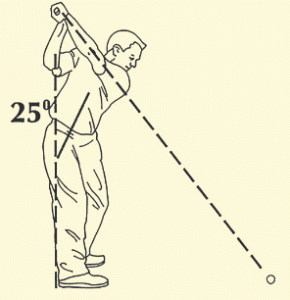 One swing required with 25 Degree Golf!