

Pre-Shot Routine
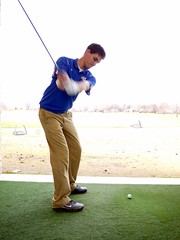 Photo by proforgedAll athletes seek consistency, especially golfers. And, all golfers will tell you that consistency in their game is a fleeting thing. However, one of the best ways to improve consistency is to employ a pre-shot routine.
A pre-shot routine is a sequence of repeated actions which readies the mind and body for the upcoming shot. A pre-shot routine has many important features which promote consistency.
First, it helps relax the golfer, because during this routine, the golfer takes a couple of deep, relaxing breaths. Relaxation promotes a consistent, rhythmic swing.
Second, a pre-shot routine helps with concentration. Once the pre-shot routine starts, the golfer focuses on only one thing – hitting the golf ball.
Third, it builds confidence, because the golfer will use positive visualization at the start of the routine. A golfer who is focused on the task at hand and who is confident about his abilities will produce consistently good swings.
A pre-shot routine can benefit both your students and professionals. My suggestion to you is find out what works best for you and use it in your pre-shot routine. For example, try visualizing the ball landing at the desired spot before you hit the shot. Or, try visualizing yourself on a TV screen making a smooth swing before every shot.
The important point I want to stress is get a routine that you feel comfortable with and use this routine before every shot. Don’t rush your routine in pressure situations. Keep the same tempo in you routine that you would like in your golf swing.
Photo by proforgedAll athletes seek consistency, especially golfers. And, all golfers will tell you that consistency in their game is a fleeting thing. However, one of the best ways to improve consistency is to employ a pre-shot routine.
A pre-shot routine is a sequence of repeated actions which readies the mind and body for the upcoming shot. A pre-shot routine has many important features which promote consistency.
First, it helps relax the golfer, because during this routine, the golfer takes a couple of deep, relaxing breaths. Relaxation promotes a consistent, rhythmic swing.
Second, a pre-shot routine helps with concentration. Once the pre-shot routine starts, the golfer focuses on only one thing – hitting the golf ball.
Third, it builds confidence, because the golfer will use positive visualization at the start of the routine. A golfer who is focused on the task at hand and who is confident about his abilities will produce consistently good swings.
A pre-shot routine can benefit both your students and professionals. My suggestion to you is find out what works best for you and use it in your pre-shot routine. For example, try visualizing the ball landing at the desired spot before you hit the shot. Or, try visualizing yourself on a TV screen making a smooth swing before every shot.
The important point I want to stress is get a routine that you feel comfortable with and use this routine before every shot. Don’t rush your routine in pressure situations. Keep the same tempo in you routine that you would like in your golf swing.




 Michelle Wie has reached the top of her wide, well-coiled, and majestic top of backswing position. What happens next to get her started in delivering all this power to that teed up ball? I will answer that question shortly. Right now, I think it is crucial to first present the three popular theories or arguments about what happens to complete the backswing and start the downswing.
Theory #1
There is no overlap movements in the two halves of the swing. As the player has just about but not quite finished turning his or her body, while the hands and the club have not quite reached their highest point in the backswing, the player actually starts the downswing by shifting the hips later – ally toward the target. This lateral move of the hips puts so much stress on the coil of the upper body, that it is automatically forced to begin uncoiling, like a taut rubber band whose tension is released, snapping the band back. (I disagree with this movement-in-two- directions-at-the-completion of- the-backswing concept. I don’t think it is physically impossible for any golfer to consciously and successfully make a lateral move with the hip toward the target while the hands and the club are still going up to the top of the backswing.)
Theory #2
The player winds the hips and shoulders so far around in a clockwise direction that the force of the windup catapults the arms, body, and club down, due to centrifugal force. In other words, the downswing is triggered automatically. (Although I agree that centrifugal force plays a key role in the downswing, by virtue of the arms and club swinging outward from the body’s center toward the ball, I don’t agree with the theory that the downswing just happens by some form of houdini-like magical spring-back action. On the contrary, it must be triggered by a specific move.)
Theory #3
The theory of synchronization calls for the player to first start the backswing by rotating the left knee inward, turning the left shoulder under the chin, coiling the left hip clockwise, and pushing the club away with the left hand on the backswing. Second, to trigger the downswing action by doing the opposite – simultaneously turning the left knee outward toward the target, rotating the left shoulder up and away from the chin, uncoiling the left hip in a counterclockwise direction, and pulling the club down with the left hand. (I disagree with this theory on the basis that it is un-natural for a right handed player to employ left hand triggers. In fact, you’ll soon be hearing more on this subject.)
I’ve just cited the three main theories when, in fact, the list goes on and on; it’s so exhaustive that you can appreciate why so many amateur golfers are befuddled. The reason: I believe many teachers are too hung up on left side golf than right side golf.
Michelle Wie has reached the top of her wide, well-coiled, and majestic top of backswing position. What happens next to get her started in delivering all this power to that teed up ball? I will answer that question shortly. Right now, I think it is crucial to first present the three popular theories or arguments about what happens to complete the backswing and start the downswing.
Theory #1
There is no overlap movements in the two halves of the swing. As the player has just about but not quite finished turning his or her body, while the hands and the club have not quite reached their highest point in the backswing, the player actually starts the downswing by shifting the hips later – ally toward the target. This lateral move of the hips puts so much stress on the coil of the upper body, that it is automatically forced to begin uncoiling, like a taut rubber band whose tension is released, snapping the band back. (I disagree with this movement-in-two- directions-at-the-completion of- the-backswing concept. I don’t think it is physically impossible for any golfer to consciously and successfully make a lateral move with the hip toward the target while the hands and the club are still going up to the top of the backswing.)
Theory #2
The player winds the hips and shoulders so far around in a clockwise direction that the force of the windup catapults the arms, body, and club down, due to centrifugal force. In other words, the downswing is triggered automatically. (Although I agree that centrifugal force plays a key role in the downswing, by virtue of the arms and club swinging outward from the body’s center toward the ball, I don’t agree with the theory that the downswing just happens by some form of houdini-like magical spring-back action. On the contrary, it must be triggered by a specific move.)
Theory #3
The theory of synchronization calls for the player to first start the backswing by rotating the left knee inward, turning the left shoulder under the chin, coiling the left hip clockwise, and pushing the club away with the left hand on the backswing. Second, to trigger the downswing action by doing the opposite – simultaneously turning the left knee outward toward the target, rotating the left shoulder up and away from the chin, uncoiling the left hip in a counterclockwise direction, and pulling the club down with the left hand. (I disagree with this theory on the basis that it is un-natural for a right handed player to employ left hand triggers. In fact, you’ll soon be hearing more on this subject.)
I’ve just cited the three main theories when, in fact, the list goes on and on; it’s so exhaustive that you can appreciate why so many amateur golfers are befuddled. The reason: I believe many teachers are too hung up on left side golf than right side golf.


