Learning Something New

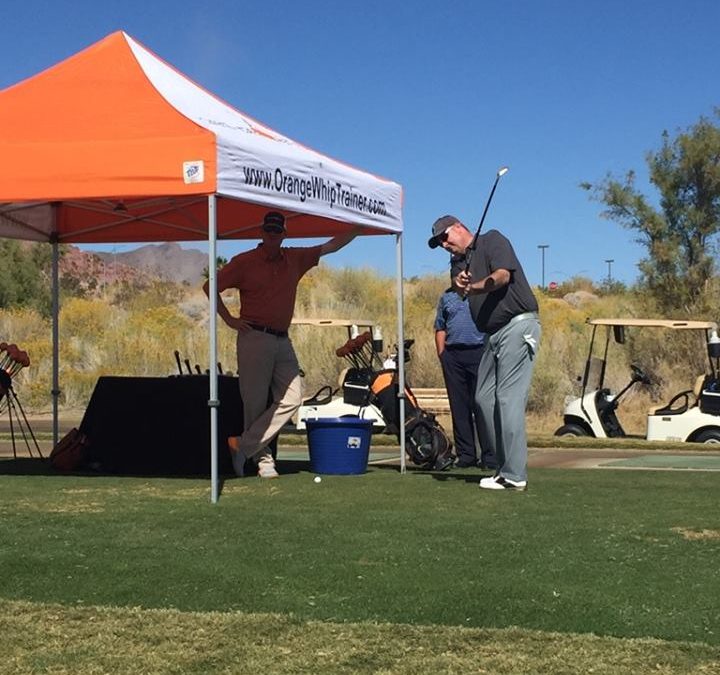
By Cole Golden, WGTF Master Golf Teaching Professional A month ago at the World Golf Teachers Cup at Boulder Creek Golf Club in sunny Las Vegas, a demo day was held before the tournament started.  Different teaching-aid manufacturers were in attendance to share the latest and greatest in technology to make improvements to one’s game.  Like most teaching professionals, we have our go-to training aids.  I spent almost two hours visiting with the reps of these training aids. During my visits with each vendor, I continuously learned new things.  It made me laugh, because I always feel like we need to grow our skill set as teaching professionals, and an opportunity presented itself to help me do just that.  An even bigger benefit was that I noticed I wasn’t the only one.  Over half of the players in the tournament were listening and learning from these folks.  The dialog between our members was amazing.  Golf swing theory, ideas, and solutions to problems were abundant in every conversation.  When I returned home, I was extremely excited to show off the new training aids I had purchased, and share the knowledge I had learned with everyone from my wife to my children to my students.  My enthusiasm was contagious and it spread; business is even picking up because word is getting out on the success I’m having with these new tools. This is an important fact to keep at the forefront of our minds:  as teaching professionals, we must keep learning . . . no different than college instructors, doctors or nurses.  There are so many ways to obtain knowledge: attending a demo day or the USGTF Masters class, visiting with other instructors, or reading books.  Our skills and our success depend on continuing education.  Would you prefer to go to a dentist who is up to speed on the latest and greatest technology, or one who has an antiquated practice?

Continuous learning sharpens our ability to serve others and stay passionate about what we do. The energy that comes from discovering new ideas and applying them can completely transform how we approach our craft. This mindset extends far beyond the fairway—it’s about constantly challenging ourselves to grow, experiment, and refine our techniques for the benefit of those who trust us. When a teacher or coach keeps learning, their students can feel it, and the results speak for themselves.

In much the same way, a dentist summerlin nv who values ongoing education brings that same spirit of growth into patient care. By staying informed on the latest dental technologies, materials, and treatment techniques, they ensure every visit feels both advanced and reassuring. Modern dentistry is not only about fixing problems but also about providing experiences that blend precision, comfort, and innovation. From digital imaging and minimally invasive procedures to cosmetic enhancements that boost confidence, patients benefit most when their dentist embraces the newest advancements with enthusiasm.

As we come close to another wonderful year in the books, I challenge everyone to make it a goal to learn more this year. Continue to expand your skills and garner knowledge.  Take it one step further and share your ideas and the teaching aids you implement that make you more successful – both personally and professionally.  Happy learning!


Walk The Walk

Walk The Walk

By David Hill USGTF Master Golf Teaching Professional®, Sherbrooke, Quebec, Canada

Seldom do I discuss or write about any of my accomplishments in golf because firstly, they are few and far between, and secondly, no one really cares. This past winter, however, I took it upon myself to set a goal to qualify for the MSOP putting championship to be held in late October in Las Vegas.

Many have perhaps seen the promotional campaign for the MSOP (Major Series Of Putting) on Golf Channel in certain markets throughout the country. This article is not to promote MSOP, but since they are from my home town of Montreal, it offered a great opportunity to get the competitive juices flowing through season-long events, and ultimately their home base “Tour Championship” in which MSOP will be sending two players to Vegas to compete against players throughout North America.

This is no small potatoes, as there will be some serious cash on the line as competitors will putt in various televised events and formats on a custom-built Jack Nicklaus designed artificial green inside a temporary stadium with Brad Faxon as the ambassador.

As a full-time coach to young athletes competing professionally, in the NCAA and at the highest ranks of junior golf, I felt it necessary to step into the competitive arena once again as I haven’t done so in many years. With little time to work on my game, what easier way to re-acclimatize myself to the pressures of competitive golf than putting? I’ve documented in previous articles my issues with the yips, but have learned to override them. If I could get my way to Vegas, then I could really test those issues under an even higher level of scrutiny and pressure. This is the test. If you’re going to talk the talk as a professional coach, then you better be prepared to walk the walk. Turning the big “Five-O” later this year, I relish the idea of qualifying for the Senior European Tour within a couple of years.

This brings me to the true point of this article, and a question that must be asked: How important is it for a coach or teacher to compete? In the grand scheme of things, probably not very important at all, as our role is to help our golfers and competitive players play their best. If, however, you’ve never competed, I believe you have a duty to do so at least once in order to fully grasp the range of emotions golfers of all levels experience. Whether it is a newer golfer teeing it up on the first tee with two foursomes behind watching while waiting to tee off, or coming down the stretch in a tough battle for a championship with your heart beating and adrenaline flowing, these now become experiences you can relate with and pass onto your students.

With 18 holes to play on the green at the MSOP home base Tour Championship, my palms were sweating and heart rate was elevated, needing to not simply hold on but make some birds as my lead was only one. Hope to see some familiar faces in Vegas. See you in October. Bring it on!
The Putting Assessment

The Putting Assessment

By Bert Jones USGTF Certified Golf Teaching Professional® Loomis, California

Many have said that putting is nothing more than line and speed. If so, then we would see more players making their putts. Putting deserves more attention from teaching professionals to help their students understand that it is more than just line and speed.

Why should you place so much emphasis on putting?

Putting is statistically 50 percent of your score, providing that you have hit every green in regulation and two-putt. But let’s say you shoot 72 with 30putts, yielding 41.6 percent of strokes being putts. It is still a large percentage of the game, and that is why we need to be better at teaching and assessing our students.

Before you assess a player, ask some questions to better understand their expectations. The number one expectation I hear is that they want to avoid three-putts. A simple solution would be to get the ball closer to hole with their irons. However, we need to dive deeper to better understand what they really expect, and whether or not their expectations are realistic. Using the acronym SMART (which stands for specific, measureable, attainable, realistic and time-based) is a tool I use to set expectations. Questions are asked to pinpoint what the player expects.

Many players think that they should be making putts 75 percent of the time or greater in the range of 6-to-10 feet. This expectation is clearly unrealistic. In every instance, my students are amazed that, on average, tour players only make 50-to-60 percent of putts from six feet. In addition, tour players make 99 percent of putts from three feet. The statistics lay the foundation for expectation and goal setting.

Once you reach agreement on the SMART goal, it is time to move on to assessing the player. As you know, putting has four major components:1) the golf ball, 2) the putter, 3) the golf green, and of course, 4) the player. We need to assess each of these components to adequately understand what needs to change.

The golf ball – Not all golf balls react the same at impact. Some are soft and others produce a different sound when struck. The key is using the same ball every time to produce consistency.

The equipment (the putter) – First and foremost, I want to know if the player has ever been fitted for a putter. I explain that being fitted will not make them a great putter, but it will ensure that their equipment does not disadvantage them. There are eight items that I look for when evaluating and fitting a putter:

1) Length 2) Loft 3) Alignment lines 4) Grip size and type 5) Milled vs. inserts 6) Toe hang 7) Putter type: mallet, blade, etc. 8) MOI (moment of inertia)

The golf green (greens reading) – Most students do not understand greens reading, and do not have a fully developed pre- and post-shot putting routine. As a result, many fail under pressure. There are two major greens reading programs that take the guesswork out of greens reading, Aim Point and Vector Green Reading. Teaching a greens-reading process provides a methodical way to read greens. Your teachings should include a pre- and post-routine that includes breath control (i.e. Heart Math, www.Heartmath.com). These processes should be consistent every time you putt.

The player (setup, stroke path, impact, and speed control) – There are a multitude of ways to putt and get the ball in the hole. It is important to assess all four elements listed above. Here are three ways to assess a player: 1) LORD’s Test (based on the Titleist Performance Institute Golf Level Two), 2) Dave Pelz’s seven putting assessments, and 3) The Four Elements Putting Assessment, based on Eye line Golf. The assessments are similar, but offer different perspectives on grading.

LORD’s Assessment – grade students by giving them 1 to 5 points by putting from different angles and distances. Points are awarded thusly: correct side of the hole, right amount of break, aim point, starts on line, and good speed.

Dave Pelz Assessment – assesses seven areas of interest: 3-foot putts, 6-foot putts, makeable putts(10 to 20 feet), breaking putts (with at least six inches of break), intermediate putts (20 to 30 feet), long lag putts (35 feet or more), and three-putt avoidance. Details about the assessment can be extracted from the Pelz book titled Dave Pelz’s Putting Bible.

The Four Elements Putting Assessment – grades students A, B, C, D and X by having them complete 10 different putting tests. Details on how to administer the assessment can be found by visiting the Eye line Pro website, www.EyelineGolfcom. Measure everything; otherwise, you are guessing!
A Revolutionary Approach to Putting

A Revolutionary Approach to Putting

By Dr. Gerald A. Walford USGTF Certified Golf Teaching Professional® The Villages, Florida

Take a golf ball and pick a target, either on a golf green or your carpet at home. Crouch or bend over as you would in rolling a bowling ball. Roll the ball to the target. Chances are you rolled the ball accurately. You have just executed the way you should putt.

You stood facing the target, looked at the target and rolled the ball with your dominant arm. You did not use two hands, because if you used two hands it would be difficult to roll the ball accurately. The roll is a one-arm swing. You did not tell yourself how hard to roll the ball. You looked at the target and your eyes told your muscles how hard to roll the ball.

Very often when putting, we putt with two hands facing 90° away from the target. We look at the target, tell ourselves how hard to hit the ball, then look at the ball and then stroke the ball. Very often, if the first putt was long, our next putt was short. When the first putt goes long, we tell ourselves to hit the next putt easier, and as a result, we end up short. This dilemma occurs when our mind is telling us how hard to hit the putt and the eyes are telling us how hard to hit the putt. This results in confusion between the eyesight and the mind.

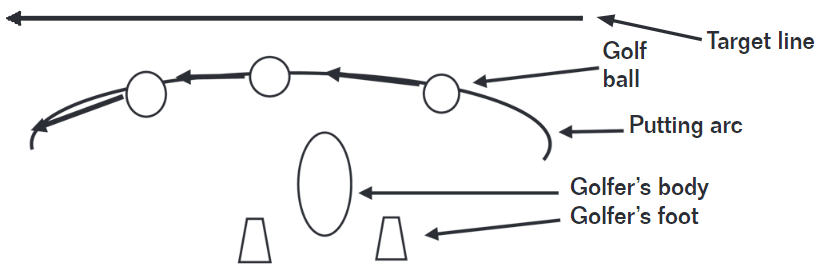
We practice trying to take the putting stroke straight back and straight through. With the conventional stance, we are fighting biomechanics and the laws of physics. When we stand erect, our arms swing around the body in an arc and so does the putter head. Ball placement in this arc must be accurate or the ball will go to the right or to the left of the target.

Come funziona il Plinko nei casino online secondo CasinosPlinko

Il Plinko è uno dei giochi da casinò online che ha registrato la crescita più rapida negli ultimi anni, passando da una curiosità di nicchia a uno dei titoli più richiesti sulle piattaforme di gioco digitale europee. Originariamente ispirato al celebre segmento del programma televisivo americano The Price Is Right, andato in onda per la prima volta nel 1983, il gioco ha subito una profonda trasformazione per adattarsi all’ambiente dei casinò virtuali. La meccanica di base rimane riconoscibile — una pallina che cade attraverso una griglia di pioli e atterra in slot con moltiplicatori diversi — ma l’implementazione digitale ha aggiunto livelli di complessità, personalizzazione e potenziale di vincita che il formato televisivo originale non poteva offrire. Comprendere come funziona davvero il Plinko nei casinò online richiede un’analisi che va oltre la superficie visiva del gioco, toccando aspetti tecnici come i generatori di numeri casuali, la volatilità, il ritorno al giocatore e le varianti disponibili sul mercato.

La meccanica di base e il ruolo del generatore di numeri casuali

Nel Plinko digitale, ogni lancio della pallina è governato da un algoritmo chiamato RNG, ovvero Random Number Generator. Contrariamente a quanto potrebbe sembrare guardando l’animazione grafica, la pallina non “cade davvero” attraverso i pioli in senso fisico: il risultato finale è determinato matematicamente dall’RNG prima ancora che l’animazione inizi a riprodursi. L’animazione serve esclusivamente a rendere l’esperienza visivamente coinvolgente, ma non ha alcuna influenza sull’esito del gioco. Questo è un aspetto fondamentale che molti giocatori non conoscono e che distingue nettamente il Plinko online da qualsiasi versione fisica del gioco.

Gli RNG utilizzati dai principali sviluppatori di software — tra cui Spribe, BGaming e Hacksaw Gaming, che hanno tutti rilasciato versioni proprie del Plinko tra il 2019 e il 2022 — sono certificati da enti indipendenti come eCOGRA, iTech Labs o GLI (Gaming Laboratories International). Questi enti verificano che l’algoritmo produca sequenze di numeri statisticamente casuali e che il comportamento del gioco nel lungo periodo corrisponda ai parametri dichiarati dall’operatore, in particolare per quanto riguarda l’RTP.

La struttura della griglia varia da sviluppatore a sviluppatore, ma generalmente si compone da 8 a 16 righe di pioli. Più righe ci sono, più percorsi possibili esistono per la pallina, e di conseguenza la distribuzione delle probabilità si avvicina maggiormente a una curva normale: le slot centrali vengono colpite con frequenza molto maggiore rispetto a quelle agli estremi. Questo ha un’implicazione diretta sul profilo di rischio del gioco: le slot centrali offrono moltiplicatori bassi (spesso inferiori a 1x, il che significa una perdita netta), mentre quelle agli estremi possono offrire moltiplicatori che in alcune versioni arrivano fino a 1000x o anche oltre. La scelta del numero di righe è quindi una decisione strategica che incide profondamente sulla varianza della sessione di gioco.

Un altro parametro configurabile in molte versioni è il livello di rischio, solitamente suddiviso in basso, medio e alto. A parità di numero di righe, il livello di rischio modifica la distribuzione dei moltiplicatori: con rischio basso, i valori sono distribuiti in modo più uniforme e le perdite nette sulle slot centrali sono meno severe; con rischio alto, la differenza tra slot centrali e laterali si accentua drasticamente, rendendo il gioco molto più volatile. Questa configurabilità è una delle ragioni per cui il Plinko ha trovato un pubblico così ampio: riesce a soddisfare sia i giocatori conservativi che cercano sessioni prolungate con piccole variazioni di bankroll, sia quelli che puntano a vincite significative accettando un rischio elevato.

RTP, volatilità e matematica del gioco

Il Return to Player (RTP) è la percentuale teorica delle scommesse totali che il gioco restituisce ai giocatori nel lungo periodo. Per il Plinko, i valori di RTP dichiarati dai principali sviluppatori si collocano generalmente tra il 97% e il 99%, con alcune versioni specifiche che raggiungono il 99% nelle configurazioni a basso rischio. Questi valori sono superiori alla media di molti slot tradizionali, che si attestano spesso tra il 94% e il 96%, e questo ha contribuito alla popolarità del Plinko tra i giocatori più attenti alla matematica del gioco.

Tuttavia, è fondamentale non confondere un RTP elevato con una garanzia di profitto nel breve periodo. L’RTP è un valore statistico calcolato su milioni di round: un singolo giocatore che completa 100 o 1000 round può sperimentare risultati molto distanti da quella percentuale teorica, specialmente nelle configurazioni ad alta volatilità. La volatilità, o varianza, misura quanto frequentemente e quanto intensamente i risultati si discostano dal valore atteso. Un gioco con alta volatilità e RTP del 99% può comunque produrre lunghe sequenze di perdite consecutive, seguite da rare vincite molto elevate.

Per calcolare la probabilità di una specifica slot in una griglia Plinko, si utilizza la distribuzione binomiale. In una griglia a 12 righe, ad esempio, la pallina incontra 12 pioli, e in corrispondenza di ciascuno devia a sinistra o a destra con probabilità pari (0,5 ciascuna, in assenza di bias). Il numero di deviazioni a destra determina quale slot verrà colpita. La probabilità di colpire la slot più a sinistra (0 deviazioni a destra) è (0,5)^12, ovvero circa 0,024%, mentre la probabilità di colpire la slot centrale (6 deviazioni a destra su 12) è C(12,6) × (0,5)^12, pari a circa 22,6%. Questa asimmetria matematica è il cuore del gioco e spiega perché i moltiplicatori più alti devono necessariamente essere posizionati sulle slot laterali per mantenere un RTP equilibrato.

Portali specializzati come http://casinos-plinko.com/ hanno documentato nel dettaglio le differenze tra le varie versioni del gioco disponibili sul mercato italiano ed europeo, analizzando le tabelle dei moltiplicatori e i profili di rischio di ciascun sviluppatore, informazioni utili per chi vuole approcciare il gioco con una comprensione più approfondita della matematica sottostante.

Un aspetto spesso trascurato è la differenza tra RTP nominale e RTP effettivo in funzione della configurazione scelta. In alcune versioni del Plinko, l’RTP varia a seconda del livello di rischio selezionato: la configurazione a basso rischio può avere un RTP del 99%, quella a medio rischio del 98% e quella ad alto rischio del 97%. Questo significa che i giocatori che cercano le vincite più elevate attraverso la configurazione ad alto rischio stanno implicitamente accettando non solo una volatilità maggiore, ma anche un vantaggio matematico leggermente superiore per la casa. Conoscere questi dettagli permette di prendere decisioni di gioco più informate.

Le principali versioni del Plinko disponibili nei casinò online italiani

Il mercato italiano del gioco online è regolamentato dall’Agenzia delle Dogane e dei Monopoli (ADM), che ha stabilito requisiti specifici per la certificazione dei giochi e la tutela dei giocatori. I casinò che operano legalmente in Italia devono ottenere una concessione ADM e possono offrire solo giochi certificati da laboratori accreditati. Questo quadro normativo ha influenzato anche la disponibilità delle diverse versioni di Plinko sul mercato nazionale.

La versione di Spribe, lanciata nel 2019, è stata una delle prime a raggiungere una diffusione significativa sui casinò online europei e italiani. Questa versione si distingue per un’interfaccia minimalista e per la possibilità di configurare fino a 16 righe con tre livelli di rischio, per un totale di 48 combinazioni diverse di parametri di gioco. L’RTP dichiarato è del 99% nella configurazione standard, un valore che ha attirato l’attenzione degli operatori e dei giocatori più esperti.

BGaming ha rilasciato la propria versione nel 2021, introducendo alcune innovazioni rispetto al modello di Spribe. In particolare, BGaming ha aggiunto la funzione di autoplay con limiti configurabili di perdita e vincita, e ha implementato una modalità “multi-ball” che consente di lanciare simultaneamente più palline per sessione, aumentando il ritmo di gioco e modificando il profilo statistico dell’esperienza. La versione di BGaming ha anche una grafica più elaborata e opzioni di personalizzazione dell’interfaccia più ampie.

Hacksaw Gaming, noto principalmente per i suoi gratta e vinci digitali, ha sviluppato una versione di Plinko con caratteristiche ibride, incorporando elementi tipici degli slot game come simboli speciali e funzioni bonus. Questa versione si rivolge a un pubblico abituato ai giochi slot tradizionali che vuole avvicinarsi al Plinko mantenendo una familiarità con meccaniche già conosciute. L’RTP di questa versione è leggermente inferiore, attestandosi intorno al 97%, ma la presenza di funzioni bonus può generare vincite significativamente superiori alla media.

Oltre a queste versioni software, esiste anche il Plinko in formato live, proposto da alcuni operatori attraverso studi di trasmissione in diretta. In questo caso, una vera pallina fisica viene lanciata su una vera tavola Plinko, con il risultato trasmesso in streaming ai giocatori. Questa versione, pur mantenendo l’elemento fisico che molti giocatori apprezzano, è soggetta a limitazioni pratiche in termini di velocità di gioco e configurabilità dei parametri, e ha una diffusione più limitata rispetto alle versioni puramente digitali. CasinosPlinko ha analizzato in modo approfondito anche questa variante, evidenziando le differenze in termini di RTP e meccaniche di gioco rispetto alle versioni RNG.

Strategie di gestione del bankroll e comportamenti di gioco responsabile

Il Plinko, come tutti i giochi da casinò, è un gioco a somma negativa nel lungo periodo: il vantaggio matematico della casa, anche se ridotto rispetto ad altri giochi, garantisce che l’operatore sia in profitto nel lungo termine. Nessuna strategia di scommessa può invertire questo vantaggio matematico strutturale. Tuttavia, una gestione consapevole del bankroll può influenzare significativamente l’esperienza di gioco, la durata della sessione e la probabilità di terminare una singola sessione in profitto.

Una delle strategie più diffuse tra i giocatori esperti di Plinko è la gestione della dimensione della scommessa in funzione del livello di rischio scelto. Con configurazioni ad alto rischio, dove la varianza è elevata e le perdite consecutive possono essere significative, è consigliabile ridurre la dimensione della singola scommessa rispetto al bankroll totale disponibile. Una regola empirica comune è non superare l’1-2% del bankroll per singolo round nelle configurazioni ad alta volatilità, per garantire un numero sufficiente di round che permetta alla distribuzione statistica di manifestarsi in modo più prevedibile.

Con configurazioni a basso rischio, dove i moltiplicatori sono distribuiti in modo più uniforme e le perdite nette sulle slot centrali sono contenute, è possibile aumentare leggermente la percentuale di bankroll per round senza esporre il capitale a rischi eccessivi. Questo approccio permette sessioni di gioco più lunghe e un’esperienza meno stressante, anche se riduce la possibilità di vincite molto elevate in un singolo round.

Il gioco responsabile è un tema centrale nella regolamentazione italiana del settore. L’ADM impone ai casinò con licenza italiana di implementare strumenti di autoesclusione, limiti di deposito configurabili dal giocatore e messaggi informativi sui rischi del gioco d’azzardo. I dati del settore indicano che circa il 3-4% dei giocatori online sviluppa comportamenti problematici legati al gioco, una percentuale che sottolinea l’importanza di un approccio consapevole. Piattaforme come CasinosPlinko includono sezioni dedicate al gioco responsabile nelle proprie analisi, evidenziando come la trasparenza sulle meccaniche matematiche del gioco sia uno strumento essenziale per promuovere comportamenti più consapevoli tra i giocatori.

Un aspetto specifico del Plinko che può influenzare il comportamento dei giocatori è la velocità di gioco. A differenza degli slot tradizionali, dove ogni spin dura pochi secondi, il Plinko ha un’animazione leggermente più lenta che può dare l’impressione di un ritmo più controllato. Tuttavia, nelle versioni con autoplay o multi-ball, la velocità effettiva di consumo del bankroll può essere molto superiore a quanto il giocatore percepisca intuitivamente. Impostare limiti di perdita e vincita prima di iniziare una sessione è una pratica raccomandata da tutti gli esperti del settore, indipendentemente dal tipo di gioco scelto.

In conclusione, il Plinko nei casinò online è un gioco che combina semplicità apparente e complessità matematica reale. La sua popolarità crescente è il risultato di una formula che riesce a essere accessibile per i nuovi giocatori e allo stesso tempo sufficientemente ricca di variabili configurabili per attrarre i giocatori più esperti. Comprendere il funzionamento degli RNG, i parametri di RTP e volatilità, le differenze tra le versioni disponibili e i principi di gestione del bankroll permette di affrontare il gioco con una prospettiva più informata e razionale, riducendo il rischio di decisioni impulsive e aumentando la qualità complessiva dell’esperienza di gioco.

We buy putting aids, we use many tricks like different hand positions, different hands low, different stances, and nothing works. With lots of practice, some of these idiosyncrasies may work, but very often, not for long.
Putting is a one-armed stroke. We did not roll the ball to the target with two hands. The following is a putting method, called revolutionary by some, and loved by many because of the success they have achieved stroking the ball to the target with excellent distance control.

Select your putter. The length of the putter does not matter. Just remember, with the long putter, do not anchor the end of the putter to your body. Instead, you will anchor your elbow nearest the target to the side of your body. This stabilizes the top hand for the putting stroke. The length of the putter will determine the amount your body will bend over.

The top hand or arm anchors to the body with the elbow no matter the length of the putter. This arm is your stabilizer. It stabilizes the putter for the stroke. The lower hand assumes a split grip that can vary in length, but give it a good split because this is your putting stroke just like you rolled the ball to the target with your hand.

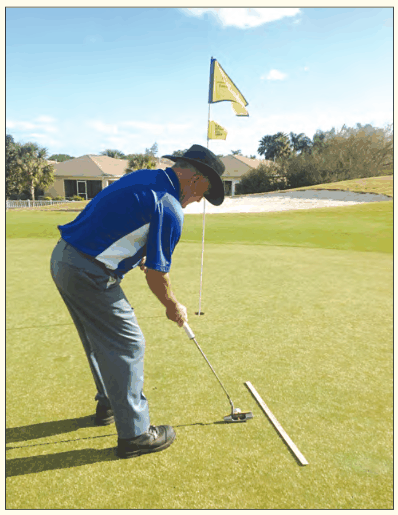
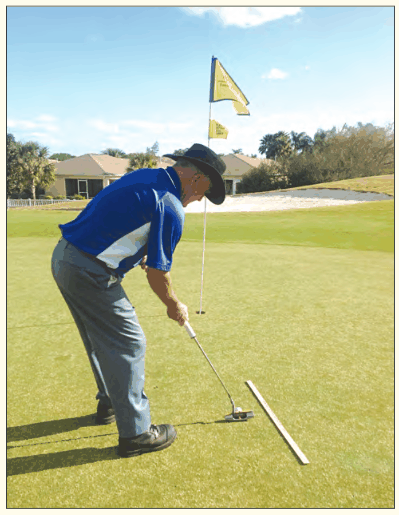
This is the stance. An open stance is used to aid in the putter moving straight back. The front elbow is locked to the body instead of the putter locking to the body. Individual preference will determine the amount of open stance needed. The yard-stick shows the target line.

The body is in an open position, very much open, at least 45°. As you will notice in the photos, simply pull the back arm and elbow back and then push the forearm forward through the ball to the target. You will notice the putter head go straight back and straight through naturally to the target. This is the key. The open stance gives the pull-back by the elbow a straight line to the stroke and target. This is natural and within the laws of physics; no adjustments to the swing are made. The putt must go straight.

Try this. With a ball in hand, roll it to a target and notice how far your hand swings back and through. Do this several times until you get a good feel as to how far the ball rolls with how far your hand swings back. Do the same thing with different targets and different lengths. Now take your putter and putt the ball to these targets. You will notice and feel how the hand swung back the same distance with the putter as when you rolled the ball to the same target.

I taught this to a club pro, and his routine for every putt would be to swing his arm with an imaginary ball to the target. He then got the feel for the putt’s distance. He would then stroke the ball to the same arm swing. He qualified for the U.S. Open.

As an aid to distance control, some have found that for every inch of backswing the ball will roll 1 foot or 2 feet depending on the individual. Some will take their putter and use the length of the putter blade to determine their backswing length. If the putter is 4 inches long, a golfer can measure 4, 8, 12 inches, etc., for his backswing length. The golfer can then place the back foot at this length and swing the putter back to the toe and then through the ball.

As you go to putt, look at the hole and feel the distance. Then look at the ball and stroke the ball quickly. Wait too long and the feel will be lost. Do not tell yourself how hard to stroke the ball. The eyes know and have told the body. As you stroke the ball, keep the image of the target’s distance in your mind and let the feel just hap-pen as you did when you rolled the ball from your hand.

The elbow pulls back. The body is stationary. Notice how the putter blade has moved straight back. No arc.

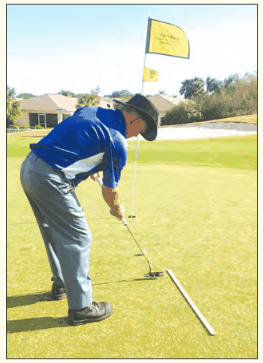
Notice how the putter blade has moved through the ball in a straight line as the back forearm is pushed to the target. No body movement except for the back shoulder which will have moved slightly to the target after the ball has been struck. The front arm is a stable rod and the back arm is a piston pushing the ball to the target.

Something’s Wrong Somewhere

Something’s Wrong Somewhere

By Bob Mullen USGTF Master Golf Teaching Professional, Wichita, Kansas

The year was 1975, and golfing legend Sam Snead had just read a Golf Digest report on the average score of the male golfer; he was dismayed to learn it was 100. He considered all the improvements he had witnessed over the years in equipment, course maintenance and availability of instruction, and concluded there was no reason the average golfer should be scoring that high. He wrote, “Something’s wrong some-where.”

With his book Simple Key Approach to Golf, Sam set out to provide simplified instruction to address what was “wrong.” This book was one of eleven books Sam wrote, believing in his books somewhere would be the answer that would help the average golfer. Snead was not alone: almost every notable professional golfer and teacher has written one or more books on the fundamentals of our game. I have read and studied the books written, not just by Snead but by Jones, Hogan, Palmer, Penick, Nicklaus and Watson, and I admit I also thought I had the answer. I gave writing my own book a try in2009.

Since the time of Snead’s statement, 40 years have passed and millions of words of instruction have been written. We now have teachers on the web, more than a dozen magazines and countless training camps, schools and academies, all teaching the basic fundamentals and giving tips on how to play the game. The equipment has undergone major changes in design. Golfers can choose steel, graphite, or composite shafts with custom kick points. Heads come in graphite, titanium, or carbon fiber with fusion technologies that can only be described as space age.

It all amounts to lighter, stronger clubs with bigger sweet spots that are easier for the golfer to hit. Courses are now immaculate in every respect, greens putt truer and, thanks to the USGTF, instruction is uniform and directed toward the correct fundamentals. Golf ball technology alone should make the game easier. All of this combines to make the golfing experience vastly improved and should result in better performance by the average golfer. It is hard to believe, but the latest report published by the National Golf Foundation in 2016shows the average male golfer still shoots 100.

So, what is the story? Sam was right in 1965, and he is still right today, something is wrong. But it’s probably not what you are thinking. If you teach what the US-GTF offers, and your students learn, they will have the opportunity to develop the best game they are capable of playing. So, if that is true, then what is wrong?

I make no claim to being an expert in neurology, but I have spent the past ten years studying how the brain works because of my involvement with post traumatic stress disorder (PTSD), and lately because of my interest in muscle movement and motor control by the brain. I have spent the last three years learning a solution to the problem. The complete answer appears in my new book, Golf: Learn from the Legends.

I can give you a good look at the answer in this article. What’s wrong is not what we are teaching, but how we are teaching. We work hard at explaining how to perform motor skills. But we don’t tell our students how they learn motor skills. We tell them to practice, but we don’t tell them how necessary this practice is and what the consequences are if they fail to practice. We don’t tell them that it all deals with the brain and how the brain absorbs information. We should all be aware by now that that muscle memory is a very inexact term often used to describe complex signals that travel from our brain to our muscles every time we need a muscle to contract or relax. Everything we do in teaching golf is teaching the brain how to send signals via electric impulses to the muscles to contract or relax so that the proper coordinated action can take place. If there is no message from the brain, there is no movement in the muscle. There is no muscle memory.

New brain-scan technologies have been developed and used on people with damaged brains. They needed to relearn everything from walking to talking. The imaging observed by the neuroscientists showed pat-terns on how this relearning was taking place. It is no longer guesswork, and we now know how motor skills are learned. First, the information goes to your frontal cortex, which is the thinking part of your brain. Here, it is memorized and the action is analyzed, and then sent to the motor cortex for assignment to muscles through the cerebellum prior to being sent to its destination via your spine. Initially, the skill is not permanently learned and must be thought about each time you want to re-peat the action. The skill must be practiced daily and it must be perfect practice, or the skill will not be learned perfectly. Each practice effort must be correct. Practice sessions must be short and exact. These sessions are building neural patterns in the motor cortex. This is called the cognitive stage of learning. It is stage one.

Since the student must rely on his/her memory in the cognitive stage, you must be aware that there is a capacity problem in the frontal cortex. This is where all the thought processes for the individual take place, and only seven items can exist in the working memory function. It is best that you do not overload the frontal cortex by trying to learn or teach more than one motor skill at a time. Do not confuse the learning process.

The object in stage one is to practice the motor skill daily. The recruiting of neurons in the motor cortex will take about 10 to 14 days. Once a sufficient bundle is created, you will have reached stage two, or the associative stage of learning. In this stage, you do not have to rely on your memory each time you want to repeat the skill. From time to time you will have problems, but for the most part you have learned this skill.

Practice of the skill in stage two refines your ability to perform. The large muscle groups are joined by the fine muscle groups, and your performance becomes smoother and you act less like a “klutz.” During the associative stage, you can take on another new skill. You may have several skills in your game that have reached the associative stage, and you should manage your practice time and drills to move them ahead to keep your game in balance.

The third stage is the autonomous stage. This is the stage you have for the majority of your motor skills like walking and eating and riding a bike. You don’t even think about how you do these tasks. This is the destination for your golf skills. Stand up to the ball and be comfortable with your swing. You can then focus on course management. That is when golf is really fun.

• Memorization takes place in Stage One in the Frontal Cortex. If you practice the skill, you can move it to the Motor Cortex. If you don’t practice, you will lose the skill.• Permanent learning begins in the Associative Stage in the Motor Cortex as neurons are recruited through repeated practice. This will happen after about ten days. Your continuous practice builds a neuron bundle in the Motor Cortex, recruiting more and more neurons and refining the muscle patterns used to perform the skill. This level begins after 10-14 days and lasts for months to years, depending on your dedication.• In Stage Three, you will recruit neurons in every region of your brain. The skill is permanent and autonomous. This takes hours and hours of dedicated and continuous practice. This is the level you want to attain.
Making The Most Of What You Have

Making The Most Of What You Have

By Mark Harman USGTF Course Director Ridgeland, South Carolina

When Sally J. Sportsman interviewed me for her article in this magazine, “Teaching and Modeling a Winning Mindset” (page 17), she asked me a question that took some thought on my part to answer: “How do you know when you’re as good as you’re ever going to get?”

It’s a question that has undoubtedly bedeviled golfers for centuries, and we see its effects on golfers today, including those in the professional ranks. It’s a question that is difficult to answer without some contemplation.

One of the allures of golf is the intermittent reinforcement nature of the game, which researchers have found is a lynchpin of addiction. Gambling also offers such reinforcement, so it’s no stretch to say that golf can become addicting. There’s also an addiction to improvement for many golfers, convinced that there must be a more automatic way for them to swing the club. Golf instruction has always been popular, but never more so than in our modern age, with YouTube videos and instructional websites, not to mention the more traditional avenues of books and magazines.

The seduction of improvement happens because, no matter how good you get at golf, you are still going to make a ton of mistakes of varying degrees. When he was at the top of his game, Ben Hogan said it was typical for him to hit only one or two shots that came off “exactly as planned.” Giving the exacting standards of Hogan, this is understandable, but it also points to an interesting paradox (and you are free to call it “Harman’s Paradox”): The better you get at golf, the fewer the shots you consider good will be hit.

On the surface, that seems to make no sense at all, because if you are getting better at golf, you must be hitting better shots, right? Of course. But the paradox is in what constitutes a good shot for a person of a particular skill level. A bogey golfer may consider it to be a good shot if he hits the green from 100 yards out, while a scratch golfer may be unhappy if he winds up with a 25-foot putt in the same situation. It is for this reason that I have often told people that I believe a lot of bogey golfers actually have more fun playing the game than many scratch golfers!

This isn’t to say that we should never strive to improve. I graduated from college with a competitive scoring average of 80.1 my senior year, hardly a harbinger of successfully playing professional golf in the future. Although the first job I landed out of college was a typical 40-hour per week job, the hours varied such that I could spend a fair amount of time working on my game. I continued to improve until I reached a 1 handicap, turned pro, and eventually won 17 professional events overall. I have advanced to U.S. Open Sectional qualifying twice, signifying I was one of the 750 best golfers in the country those respective years, so it is indeed gratifying to be able to play the game at a high level.

But still, no matter how good a round of golf I may have played, there was always the frustration of the vast majority of my shots being mishits, as strange as that may seem. So while I never came close to reaching the level of Hogan, I can understand where he’s coming from when he made his famous statement. Having said all of this, and while I do believe some scratch golfers are some of the unhappiest ones out there, it’s more satisfying to play the game at a higher level that you did previously.

Everything I’ve written so far is the setup for the question asked in the first paragraph. The best answer I can come up with is, “You can never know when you’re as good as you’re ever going to get until well after the fact.” Some examples will bear this out.

Nick Faldo was convinced in the early 1980sthat he was capable of more, and went to see David Leadbetter. After a two-year process, Faldo had completely re-worked his swing and became a six-time major champion.

Somewhere in the middle is Tiger Woods. After having played what was arguably the finest golf ever seen from the 2000 U.S. Open to the 2001 Masters, Woods left his coach, Butch Harmon, to work with Hank Haney. After a lull, Woods returned to his winning ways, capturing trophies at the same rate but not with the same dominance.

And then there are cases like Derek Ernst. After winning the Wells Fargo Championship in 2013,the very next day he set about changing his swing, saying now was the time since he had the luxury of a two-year exemption. Unfortunately, to date Ernst hasn’t notched even so much as a top-10 finish and is currently off the PGA Tour. Elite players aren’t exempt, as such luminaries as Padraig Harrington and Luke Donald have struggled to reach their former glory after changing their swings.

What kind of guidelines can we, as teachers and coaches, use to determine if a player is as good as they’re ever going to get? I think a lot of it has to do with how far the player has come. Ernst came out of nowhere to win on the Tour, meaning for one week he was the best player in the world. Why change that immediately? In Harrington’s case, he was fresh off of winning three majors in two years – that’s historical stuff. And Donald’s previous game got him to #1 in the world.

A player’s goals also have to be accurately judged by the teacher/coach. This may depend in large part on the experience of the teacher/coach with other players who undertook drastic measures to change their games. Experience in knowing what’s possible and what’s not is crucial to this decision-making process.

Finally, the player has to step back and be an objective observer, if at all possible, of his or her game. Faldo realized he had trouble closing out big tournaments and could tell his technique wasn’t re-liable. This was an obvious tell-tale sign that he had to change.

On the other hand, had Harrington said to him-self, “You know, winning three majors in two years is pretty good; let’s see how far I can take this,” he might have won another three majors the following two years. Now, we’ll never know.

More importantly, neither will he.
Coaching High School Golf

Coaching High School Golf

By Bert Jones USGTF Master Golf Teaching Professional, Loomis, California

St. Francis High School Girls Golf Team with head coach, Bert Jones.

Last season I had a chanceto coach my first girls highschool golf team. It was a suc-cessful season, and needlessto say there was a lot I didn’tknow. The purpose of thisarticle is to relate some in-formation so you can decidewhether or not you want tocoach high school golf.

First and foremost, you need to decide why youwant to coach. Hopefully you want to mentor youthand give back to the sport. Be sure to build andwrite down a coaching philosophy for all to see!

If you want to supplement your income, youneed to know the pros and cons of that decision.High schools pay by stipend, with a range of $2,100to $3,300 for a season that lasts 10-12 weeks. Youcan expect to spend about 20+ hours a week work-ing with the team, coordinating play and matches,and completing paperwork. Some high schoolsrequire the head coach to fundraise. If so, be pre-pared to spend additional hours to raise the money.

You may or may not have an assistant coach. Ifso, you will need to manage the assistant, and en-sure that they implement the schedule and plannedpractices. My school has a provision that supple-ments my pay by $450 if I have at least 10 playersand no assistant coach.

Once you start, you need to make arrangementsfor uniforms and embroidery. Team uniform order-ing, fitting, embroidery and collections for the uni-forms took up a lot of time! You must be preparedto account and manage a budget.

How many players will you have on the team? Iwas blessed to have had 13 last season. I am bettingthat I will have 15 to 18 players try out this sea-son. So, will you have cuts or no cuts? I favor cutsbecause the traveling team is limited to six play-ers. My experience showedthat only eight of the 13 everreally had a chance of playingin a match. Therefore, the otherfive were confined to the rangeand some on-course play. Iplan to limit the team to a min-imum of 10 and a maximum of14. Depending on the scoresand the numbers seeking tojoin, I would like to see no more than a 10-strokespread between the number six player and the num-ber 10 or 14 player. It is my hope to create greaterintra-squad competition. Other limiting factors arebudget and school athletic director philosophy.

There are highs and lows to coaching highschool golf. You will enjoy watching the growth ofthe team, winning matches, and individual achieve-ment. You will also enjoy working with the otherhigh school coaches; however, I was stunned attheir lack of credentials and overall golf knowledge.The lows that you will deal with are centered onaberrant parent behavior. Yes, the parents! I callthem helicopter dads or moms, those that want tohover, watch, and even coach their kids on everylittle moment. You will also experience parents thatjust want their child to play in the sport and arepretty much indifferent.

Players can be classified into three groups.Group one – the really talented, some of which arecoachable and some of which are not coachable.Some of these kids even have their own swingcoach! The second group is those that are coachableand have some talent. These kids have the abilityand just need one-on-one lessons. The last groupis those that are there for pure entertainment. Theywant to hit golf balls, listen to their iPod and havea good time.  

World Cup Recap: USA, Masih, Harman Win Titles

Team USA shot a record 9-under-par 711 to win its eighth team title out of 13 attempts at the World Golf Teachers Cup at Boulder Creek Golf Club in Boulder City, Nevada, October 18-19. Mark Harman fired a 6-under-par 66 and Kacey Tyler a 5-under-par 67 in the final round, leading the USA the final day to edge Team International 1 by five strokes. Canada came in third at 724, followed by International 2 at 765 at Great Britain & Ireland at 792.

Shafiq Masih from Canada claimed the individual title with scores of 67-70 – 137 to defeat runner-up and defending champion Rebecca Samuelsson by two strokes. Newly-crowned United States Golf Teachers Cup champion Matt Smith finished third at 70-70 – 140. Pam Montgomery won the Ladies title with scores of 80-78 – 158 to nip Mary Peter-Wolf by one stroke.

In the inaugural World Senior Golf Teachers Cup, Harman, from Ridgeland, South Carolina, defeated Tyler on the first playoff hole after both finished at 6-under-par 138. Tyler’s tee shot on the #9 hole on the Coyote Run nine went into the water after a bad bounce, and his third shot finished 20 feet from the hole. Meanwhile, Harman put his approach shot on the par-4 hole 15 feet away, and after Tyler’s par effort lipped out, Harman two-putted for the victory. It was his ninth WGTF national or international victory since competition began in 1996. Anthony Benny from Trinidad & Tobago won the Super Senior championship with 71-72 – 143 and finished fifth overall in the World Senior Cup. Ray Holder shot 75-77 – 152 to win the Legends division for players 70 and over.

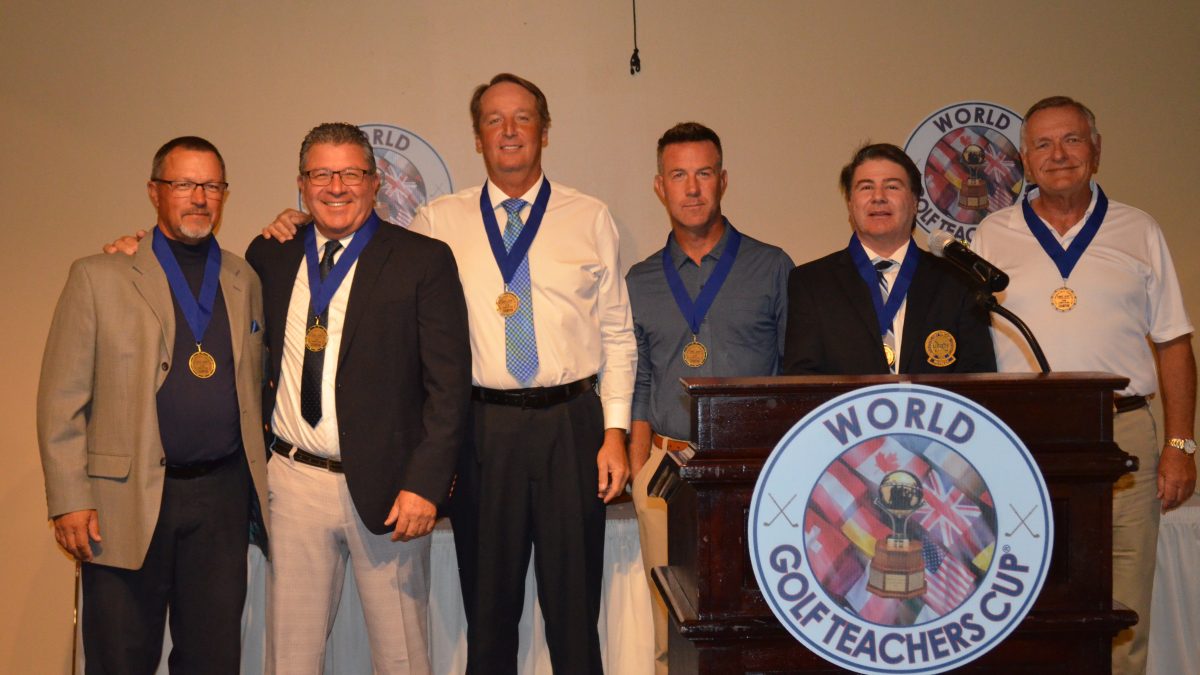
Pictured from left to right: Kacey Tyler, Jim Perez, Michael Wolf, Matt Smith, Mark Harman and Jim Grow.
An Alternative to Tee It Forward

An Alternative to Tee It Forward

Several years ago, the USGA got on board with a movement called “tee it forward,” a concept developed by Barney Adams (of Adams Golf) and supported by none other than Jack Nicklaus. The gist of the idea was for golfers to play from the 18-hole yardage that best corresponded to the distance that they hit their driver so that they would play roughly the same irons into the greens as do the pros.

The concept received much fanfare and publicity, but soon vanished from the scene as most golfers either ignored the concept, didn’t know about it, or lost interest. It was a noble idea, but asking a golfer who averages 200 yards off the tee to play from around 5,300 yards (as “tee it forward” recommends) is a tough ask, especially if that golfer is a skilled golfer for that particular driving distance. Most male golfers continued to gravitate towards white tees at golf courses, which are normally in the 6,200-yard range or so, no matter how far or short they hit the ball.

The concept of “par” is a relatively simple one to grasp. It is the score an expert golfer is expected to make on a given hole, with a certain number of strokes to reach the green and two putts for par. For male golfers, a par-3 is any hole up to 250 yards; a par-4 ranges from 251 to 470 yards, and a par-5 is 471 yards and over. (There is also a par-6 yardage, which we will omit for purposes of this discussion.)

Zašto je osnovna blackjack strategija prema Kasinovodic važnija nego ikad

Blackjack je jedna od rijetkih kasino igara u kojoj matematika stoji na strani igrača koji je spreman učiti. Za razliku od ruleta ili automata, gdje ishod svake runde ovisi isključivo o slučajnosti, blackjack nudi strukturu odlučivanja koja se može optimizirati. Osnovna strategija — skup matematički izvedenih odluka o tome kada udariti, stati, udvostručiti ili se podijeliti — nije nova ideja. Njezini temelji postavljeni su još 1950-ih godina, kada su matematičari Roger Baldwin, Wilbert Cantey, Herbert Maisel i James McDermott objavili pionirski rad u Journal of the American Statistical Association. Ono što se promijenilo jest kontekst u kojemu igrači danas sjede za stol, bilo fizički ili virtualno, i zašto je poznavanje te strategije danas relevantnija nego što je bila u bilo kojoj prethodnoj dekadi.

Matematička osnova koja se nije promijenila — ali uvjeti jesu

Osnovna blackjack strategija izvedena je iz analize milijuna kombinacija karata pomoću računalne simulacije. Edward Thorp je 1962. godine u knjizi “Beat the Dealer” popularizirao ove izračune i pokazao da igrač koji savršeno primjenjuje osnovnu strategiju smanjuje prednost kuće (house edge) na ispod 0,5 posto, ovisno o pravilima konkretnog stola. To je izvanredno nizak postotak u usporedbi s gotovo svim ostalim kasino igrama. Europski rulet, primjerice, nosi prednost kuće od 2,7 posto, dok američki rulet s dvostrukom nulom ide do 5,26 posto. Slot automati u reguliranim europskim jurisdikcijama tipično imaju RTP (return to player) između 92 i 96 posto, što znači prednost kuće između 4 i 8 posto.

Međutim, kasino industrija nije mirovala. Od 1990-ih naovamo, operateri su sustavno modificirali pravila blackjacka kako bi povećali svoju prednost. Jedna od najznačajnijih promjena jest isplata za blackjack. Klasična igra isplaćuje prirodni blackjack u omjeru 3:2, što znači da igrač koji ulozi 100 kuna dobiva 150 kuna dobitka. Sve više stolova, posebno u Las Vegasu od sredine 2000-ih, prešlo je na isplatu 6:5, što na prvi pogled izgleda slično, ali drastično mijenja matematiku. Isplata 6:5 umjesto 3:2 sama po sebi dodaje gotovo 1,4 posto prednosti kuće — što znači da čak i savršena primjena osnovne strategije ne može kompenzirati tu promjenu dovoljno da igra bude povoljna za igrača.

Osim toga, mnogi stolovi danas igraju s više špilova karata istovremeno — najčešće šest ili osam. Što je više špilova u igri, to je teže brojati karte i to su manji prirodni oscilacije u korist igrača. Pravila poput “dealer hits soft 17” (djelitelj mora uzeti kartu na mekanih 17) dodaju još 0,2 posto prednosti kuće. Svaka od ovih promjena, naizgled mala, akumulira se i čini razliku između igre s prednosti kuće ispod pola posto i igre s prednosti kuće od 2 do 3 posto. Igrač koji ne poznaje osnovnu strategiju i ne razumije ove nijanse igra pod znatno nepovoljnijim uvjetima nego što misli.

Digitalizacija i online kasina: novi izazovi za igrače

Ekspanzija online kasina dramatično je promijenila krajobraz blackjacka. Prema podacima Europskog udruženja za igre na sreću (EGBA), tržište online igara na sreću u Europi dostiglo je vrijednost od oko 29,5 milijardi eura u 2022. godini, s konstantnim rastom od oko 10 posto godišnje. Hrvatska je 2014. godine uvela regulatorni okvir za online klađenje i igre na sreću, a Ministarstvo financija redovito ažurira liste licenciranih operatera. U takvom okruženju, igrači imaju pristup desecima različitih varijanti blackjacka — od klasičnog europskog blackjacka do Spanish 21, Pontoon, Blackjack Switch i bezbroj live dealer varijanti.

Svaka od ovih varijanti dolazi s vlastitim skupom pravila i vlastitom optimalnom strategijom. Ono što vrijedi za standardni šesterošpilni blackjack ne vrijedi nužno za Spanish 21, gdje se iz špila uklanjaju sve desetice (ali ne i figure), što fundamentalno mijenja vjerojatnosti. Igrač koji pristupa ovim igrama bez razumijevanja temeljnih principa riskira primjenu pogrešnih odluka u situacijama koje izgledaju identično, ali matematički nisu.

Upravo u ovom kontekstu resursi koji sustavno objašnjavaju strategiju postaju neprocjenjivi. Stranica kasinovodic.com/ primjer je platforme koja pokriva specifičnosti različitih varijanti blackjacka na hrvatskom jeziku, što je posebno važno za igrače koji žele razumjeti kako se pravila mijenjaju ovisno o kasinu i varijanti igre. Razumijevanje tih razlika nije luksuz — to je preduvjet za informirano igranje.

Live dealer blackjack, koji je doživio eksplozivan rast između 2018. i 2023. godine zahvaljujući unapređenju streaming tehnologije i povećanoj dostupnosti brzog interneta, donosi dodatnu dimenziju. Igrači sada sjede za virtualnim stolom s pravim djeliteljem u stvarnom vremenu, što psihološki replicira iskustvo fizičkog kasina. Studije o ponašanju igrača pokazuju da live okruženje povećava tendenciju prema impulzivnim odlukama — igrači češće odstupaju od optimalne strategije pod utjecajem “atmosfere” i pritiska brzog donošenja odluka. Upravo zato je internalizacija osnovne strategije, a ne samo njezino teorijsko poznavanje, ključna za live format.

Zašto igrači sustavno griješe i kako osnovna strategija to ispravlja

Istraživanja kognitivne psihologije i bihevioralne ekonomije daju jasne odgovore na pitanje zašto prosječan igrač ne igra optimalno čak i kada tvrdi da poznaje strategiju. Jedan od najdokumentiranih fenomena jest “gambler’s fallacy” — uvjerenje da prošli ishodi utječu na buduće, što u blackjacku može rezultirati pogrešnim odlukama temeljenim na tome “što se događalo” u prethodnim rundama umjesto na matematičkim vjerojatnostima trenutne situacije.

Konkretno, istraživanje objavljeno u Journal of Gambling Studies 2019. godine analiziralo je odluke igrača blackjacka u kontroliranim uvjetima i utvrdilo da čak 78 posto ispitanika donosi suboptimalne odluke u situacijama s mekanim rukama (ruke koje sadrže as). Mekane ruke su posebno problematične jer igrači intuitivno podcjenjuju vrijednost daljnjeg uzimanja karata kada imaju, primjerice, as i šesticu (mekanih 17). Osnovna strategija jasno propisuje da igrač treba udariti ili udvostručiti u toj situaciji — ali intuicija govori “imam 17, stani”. Ta intuicija je matematički pogrešna i dugoročno skuplja.

Slična greška događa se s parovima. Mnogi igrači ne dijele parove desetica čak i kada bi to bilo matematički neutralno ili blago povoljno, jer “dvadeset je dobra ruka”. S druge strane, igrači često ne dijele parove devetki ili osmice u situacijama gdje osnovna strategija to preporučuje, jer im se čini “previše riskantno”. Ove odluke, pogrešne u obje smjeri, akumuliraju se kroz tisuće rundi i rezultiraju znatno višim house edgeom nego što igra matematički nosi.

Udvostručavanje (doubling down) je još jedno područje gdje igrači sustavno griješe, ali u suprotnom smjeru — iz pretjeranog opreza. Osnovna strategija propisuje udvostručavanje u specifičnim situacijama, poput posjedovanja 11 prema djeliteljevoj slaboj karti, jer to maksimizira očekivanu vrijednost. Igrač koji propušta ove prilike ne gubi direktno, ali propušta dobitke koji bi dugoročno kompenzirali gubitke. Matematički, to je jednako skupo kao i pogrešna odluka koja direktno povećava gubitak.

Regulatorni kontekst i odgovorno igranje: strategija kao alat samokontrole

Hrvatska agencija za nadzor igara na sreću (HANNS) od 2014. godine aktivno regulira tržište, a od 2021. godine uveden je niz mjera za zaštitu igrača koje uključuju obvezne limite depozita, mogućnost samoizuzeća i zahtjeve za transparentnost RTP-a. Slični regulatorni okviri postoje diljem EU-a — Velika Britanija kroz UKGC (UK Gambling Commission), Malta kroz MGA (Malta Gaming Authority), a Italija kroz ADM (Agenzia delle Dogane e dei Monopoli). Ovi regulatori zahtijevaju od operatera da jasno objavljuju pravila igara i povrate igrača.

U ovom kontekstu, poznavanje osnovne strategije dobiva i etičku dimenziju. Igrač koji razumije matematiku igre donosi informirane odluke. Zna koliki je stvarni trošak svake sesije igranja, može postaviti realistična očekivanja i manje je podložan iluziji da može “pobijediti kasino” dugoročno bez prednosti poput brojanja karata. Ovo je temelj odgovornog igranja — ne apstinencija, već informiranost.

Kasinovodic kao platforma konzistentno naglašava ovaj aspekt u svojem pristupu edukaciji igrača. Razumijevanje strategije nije samo alat za smanjenje gubitaka — to je i mehanizam koji igrača drži fokusiranim na matematičke realnosti umjesto na emocionalne reakcije. Igrač koji zna što treba učiniti u svakoj situaciji manje je podložan “tilt” fenomenu — emocionalnom stanju u kojemu se donose sve lošije odluke kao reakcija na prethodne gubitke.

Vrijedi napomenuti i ekonomsku dimenziju. Ako igrač igra blackjack s prosječnim ulogom od 50 eura po rundi i odigra 60 rundi po satu, ukupan volumen uloga iznosi 3.000 eura po satu. Pri prednosti kuće od 0,5 posto (uz savršenu strategiju), očekivani gubitak je 15 eura po satu. Pri prednosti kuće od 2 posto (uz tipičnog prosječnog igrača koji ne primjenjuje strategiju), očekivani gubitak raste na 60 eura po satu. Razlika od 45 eura po satu, kroz višegodišnje igranje, akumulira se u iznose koji su daleko od trivijalnih. Ovo nije teorijska razlika — to je stvarna financijska implikacija poznavanja ili nepoznavanja strategije.

Blackjack u 21. stoljeću nije jednostavnija igra nego što je bila — naprotiv, proliferacija varijanti, modificirana pravila i psihološki pritisak online i live okruženja čine ga kompleksnijim nego ikad. Osnovna strategija, koja se može naučiti i internalizirati kroz relativno kratko, ali sustavno vježbanje, ostaje jedini alat koji igraču daje matematički optimalan okvir za odlučivanje bez obzira na varijantu ili okruženje. Ona ne jamči dobitke — nijedan sustav to ne može — ali garantira da igrač ne gubi više nego što matematika igre nalaže. U industriji koja je dizajnirana da zadrži prednost, to nije mali dobitak.

For female golfers, a par-3 is any hole up to 210 yards; a par-4 covers hole 211 to 400 yards, and a par-5 is a hole 401 yards and longer. Note that for both male and female golfers, these yardages are not arbitrary as normal course conditions, topography, altitude, etc., must also be taken into account before coming up with a hole’s par.

The problem with most golfers comparing their scores to par is that they never come close to shooting it for an entire round. In fact, the average golfer doesn’t break 90, according to various statistical studies. So for them to shoot a round of par is sheer fantasy.

Currently, a concept of “par” can be made by simply assigning handicap strokes to each hole, but it doesn’t take into account the potential that golfer has. For example, merely saying an 18-handicapper’s par is 90 on a par-72 course doesn’t give that golfer an idea of what is possible for the distance he hits the ball.

What if we came up with a different concept of par, based on how far a particular golfer hits the ball? The concept of par is based on what an expert is expected to make, but an expert is also expected to be able to drive the ball at least 250 yards. What about those golfers who can’t hit it that far?

Here’s something we can try for male golfers who drive the ball less than 250 yards or a female who drive it less than 210: A golfer’s personal par based on how far he or she hits the ball. To keep things elementary, we can call this the “Personal Par System.”

First, a golfer who averages less distance than the minimum an expert is expected to hit it likely has lesser skills. So let’s subtract 30 yards from whatever yardage a good drive goes (to more accurately reflect how far an average drive might go), and assign that as the maximum length of a personal par-3 hole. Next, take another 30 yards off that figure and add it to the first to come up with a maximum length of a personal par-4, and we can also add that same figure again to come up with a maximum length of a personal par-5.

Example: Tom’s ball goes 220 yards when he hits a good drive, so a personal par-3 would be anything up to 190 yards. His personal par-4 would be from 191 to 350 yards, and a personal par-5 would be 351 to 510 yards. Using the site of this year’s U.S. and World Golf Teachers Cup (Boulder Creek Golf Club in Boulder City, Nevada, Desert Hawk/Coyote Run nines, white tees at 6,080 yards), we come up with a personal par for this golfer of 79 instead of the score-card’s 72.

A golfer who is not able to shoot his personal par now has something realistic he can strive for, and may incentivize him to put a little more time into his game. For someone who can regularly break his personal par, instead of subtracting 30 yards from the figures mentioned earlier, subtracting 20 or 10 yards may be a more accurate reflection of what a personal par should be.

Someone interested in trying the Personal Par System can take a look at the scorecard and adjust the par before the round. Some people overestimate how far they really hit it, so the system depends on an accurate accounting of driver distance.

Tee it forward was a good idea, even a great one, but it didn’t seem to catch on. We are under no great illusions the Personal Par System will become a national rage, but if USGTF members can get their students to think about their golf ability in a different way with the system, we would say our mission has been accomplished.

U.S. Cup Recap: Smith, Gulych Emerge Victorious

Having won two Open division championships in the past only to be denied by players in other divisions for the overall title, Matt Smith of Columbus, Ohio, finally realized the pinnacle of USGTF competition as he won the 22nd annual United States Golf Teachers Cup with scores of 75-69 – 144 to take a three-stroke win over Shafiq Masih and Rebecca Samuelsson. Smith, one of the toughest and most mentally-ready competitors in USGTF history, birdied three out of the first four holes to seize the lead over first-round leader Tom Alley, and he held on the rest of the way with steady play as his opponents couldn’t keep up.

Grant Gulych of St. Thomas, Ontario, had a goal to be the first to put his name on the new United States Senior Golf Teachers Cup trophy, and he succeeded when he fired rounds of 67-70 – 137 to take the inaugural playing of the tournament. Dave Belling, a two-time U.S. Cup champion and the 2003 World Golf Teachers Cup champion, finished second, four strokes back. The turning point came at the seventh hole in the final round, when Gulych made birdie to Belling’s bogey, pushing Gulych’s lead to four and he never looked back. Gulych stayed steady throughout the final nine, never faltering and didn’t give any of his nearest competitors any hope of a comeback. He also won the 2013 U.S. Cup in Tunica, Mississippi.

For complete scores of both the U.S. and World Cups, please visit www.WorldGolfTeachersCup.com.