


1994-2019…Celebrating 25 Years!
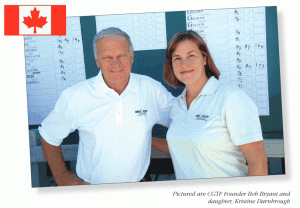 It has been 25 great years growing the game of golf in Canada! Times have changed and so have we. Reflecting back on how our federation grew and competed before the regular use of the internet and social media is astonishing. The administration team of Bob Bryant and Kristine Darnbrough, along with our pioneer members and wonderful facilitators, truly deserve a great “thank you” for their efforts, support and contributions!
Rounds played are up in Canada, and the overall participation has grown over the past few seasons after some difficult economically affected years. Canada boasts the largest percentage of population that plays golf at least once a year worldwide. So, golf in Canada is still pushing forward. The members of the Canadian Golf Teachers Federation are enjoying new opportunities and successes in the industry, thanks to golf facility operators seeking new alternatives to traditional practices. Our members’ passions and efforts are helping to re-energize facilities that have been burdened with outdated thinking and elitism that prevents new customers from feeling welcome, let alone encouraged to start.
Canada is very diverse in many ways and so is the CGTF. We have many instructors that communicate using languages beyond English and French. Lately, the CGTF certification schools have been very appealing to international participants to attend. Having a lower-trading Canadian dollar and attainable travel visas make Canada a very attractive destination to pursue a career in teaching golf. We are proud to think that we are now sharing golf in places that have no access to Golf Teachers Federation training locally.
In this 25th year, the top indicator of membership engagement has been the positive response to upgrade courses. Knowing and seeing our members wanting more information to pass along has been a welcome site. We have more Masters-level graduates this year than the past 10 years combined, and we have one more course to follow in August 2019. Golf in Canada is going very well, and the CGTF sends best wishes to all fellow World Golf Teachers Federation members!
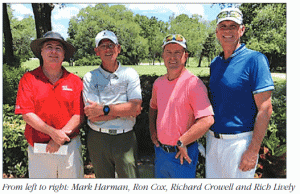 Mark Harman made a statement that he is still a force to be reckoned with at GlenLakes Country Club in Weeki Wachee, Florida, this past May. The reigning World Cup champion from Ridgeland, South Carolina, set a Southeast Region Championship scoring record of seven under par to best Ron Cox of Henderson, Tennessee, by five shots. Richard Crowell from Pensacola, Florida, and Rich Lively of Rockledge, Florida, took third and fourth, grabbing the balance from the $1,200 purse. Thanks goes out to GlenLakes head pro Tom McCrary, who has hosted us for several years.
  USGTF member Walt Abraham, head golf coach of Athenian High School in Danville, California, led his squad to the BCL-East league round-robin regular season title and also the league post-season tournament title. The team finished 9-1 in match play and next heads to the Division 2 championship tournament. The league title marks the seventh time in Abraham’s 11 seasons as head coach that Athenian has taken that honor. Athenian fields a young squad of three freshmen, one sophomore and two juniors, with three players earning all-league honors.
  Cole Golden shot an opening round 69 against a strong field that featured several current and past USGTF champions at a windy Ridgeview Ranch Golf Course, which hosted the USGTF Southwest Region Championship May 4-5 in Plano, Texas. Tough, tricky greens and somewhat wet conditions after several days of wet weather had hit Texas earlier in the week greeted the competitors. Southwest Region director Bruce Sims and Master Lee carded 76 the first day, while Brent Davies and Chris Tyner shot 77. Grant Gulych, Jeff Kennedy, and D.B. Merrill came in with 78.
 By Graham Lewis, USGTF Teaching Professional Townsend, Georgia
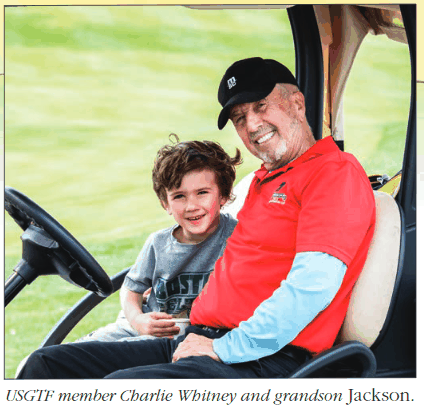
 What are the first memories that you have of golf? If you started the game as a kid, they probably have to do with a family member – usually a parent – who introduced the game to you. Many golfers look back on those days with great fondness and nostalgia.
There is no better family sport than golf. Four family members can all play in the same group, something that is difficult to do in other sports. You can indeed do the same thing in tennis if you’re playing doubles, but unless the skill level is relatively similar among the four, it can make for a difficult time. Since golf, of course, doesn’t have other players affecting your playing of the game, it doesn’t matter if there is a skill disparity, even a great one, among those in the same group.
Golf also has an amount of down time that others sports do not offer. In tennis, there is constant action. In bowling, there is always someone rolling the ball down the lane. But in golf, most of the time is spent walking or riding to the next shot, so there is ample time for conversation and bonding. Some of the best friendships golfers have were formed on the golf course. Indeed, it’s not uncommon for golfers to have mainly or only golfers as friends.
The game also tends to lend itself to easy conversation that may not be found in other venues. Those who are parents know how tough it is sometimes to have conversations with their children as they get older, especially teenagers. But for some reason, conversation while playing golf seems to come naturally for most participants.
It has been said countless times that golf is also a metaphor for life. A well-known adageis that if you want to truly get to know a person’s character, play 18 holes of golf with them. It is the rare person who changes the character and behavior they exhibit outside the course once they step onto the first tee.
Life lessons can also be imparted to our younger family members as they play the game. Perhaps a child is having a tough time that day on the course and they feel like quitting. Teaching them to persevere on the course is a good lesson that can carry them through life. Let’s face it – although we say golf is fun, it’s also difficult to excel at. If someone wants to play scratch golf or better, they have to put in countless hours over countless days over countless years, unless they are some sort of athletic freak. Golf can teach our children the valuable life values of determination and perseverance, and keeping a calm mind when things go awry.
Although the game can understandably lend itself to temper tantrums and worse, we must always remember that unless the game directly affects our well-being as a professional golfer, it’s only a game to the rest of us. How we do doesn’t affect our lives in any way, shape, or form, and it’s important to keep this perspective. These are the things that our younger family members, and sometimes even ourselves, should take to heart.
What are the first memories that you have of golf? If you started the game as a kid, they probably have to do with a family member – usually a parent – who introduced the game to you. Many golfers look back on those days with great fondness and nostalgia.
There is no better family sport than golf. Four family members can all play in the same group, something that is difficult to do in other sports. You can indeed do the same thing in tennis if you’re playing doubles, but unless the skill level is relatively similar among the four, it can make for a difficult time. Since golf, of course, doesn’t have other players affecting your playing of the game, it doesn’t matter if there is a skill disparity, even a great one, among those in the same group.
Golf also has an amount of down time that others sports do not offer. In tennis, there is constant action. In bowling, there is always someone rolling the ball down the lane. But in golf, most of the time is spent walking or riding to the next shot, so there is ample time for conversation and bonding. Some of the best friendships golfers have were formed on the golf course. Indeed, it’s not uncommon for golfers to have mainly or only golfers as friends.
The game also tends to lend itself to easy conversation that may not be found in other venues. Those who are parents know how tough it is sometimes to have conversations with their children as they get older, especially teenagers. But for some reason, conversation while playing golf seems to come naturally for most participants.
It has been said countless times that golf is also a metaphor for life. A well-known adageis that if you want to truly get to know a person’s character, play 18 holes of golf with them. It is the rare person who changes the character and behavior they exhibit outside the course once they step onto the first tee.
Life lessons can also be imparted to our younger family members as they play the game. Perhaps a child is having a tough time that day on the course and they feel like quitting. Teaching them to persevere on the course is a good lesson that can carry them through life. Let’s face it – although we say golf is fun, it’s also difficult to excel at. If someone wants to play scratch golf or better, they have to put in countless hours over countless days over countless years, unless they are some sort of athletic freak. Golf can teach our children the valuable life values of determination and perseverance, and keeping a calm mind when things go awry.
Although the game can understandably lend itself to temper tantrums and worse, we must always remember that unless the game directly affects our well-being as a professional golfer, it’s only a game to the rest of us. How we do doesn’t affect our lives in any way, shape, or form, and it’s important to keep this perspective. These are the things that our younger family members, and sometimes even ourselves, should take to heart.




 By David Vaught, USGTF Teaching Professional Bradenton, Florida
 By Mike Stevens, USGTF Teaching Professional Tampa, Florida
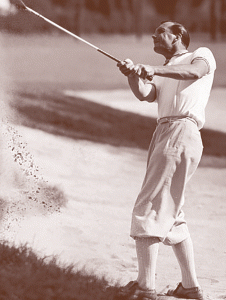 Here is where the story gets even more interesting. After a brief respite, Max headed for the first tee. As he walked, a young boy approached and asked him to sign a ball, but Faulkner was reluctant, not wanting to be distracted. Then the boy said, “You’re going to win,” and at the urging of the boy’s father who mentioned how much it would mean to the boy, Max signed the ball – Max Faulkner, Open Champion 1951. For the first time, he let the thought of blowing a big lead enter his mind, and struggled a bit coming home in 74. There were no scoreboards at the time, so runners were dispatched to and from to let people know what was going on with players still on the course. Word came in that Tony Cerda had turned in 34 and was a threat to catch the leader. A bit later, the word was that three fours on the final holes would tie Faulkner. A final messenger approached Max and related to him, “Cerda’s taken six; it’s your Open.”His dream had proved true – he was the Champion Golfer of the Year. The Claret Jug held by South African Bobby Locke would be returning to Britain.
 Of all the places that the United States Golf Teachers Cup has been played in its previous 23 years, it would be difficult to say that there was a more beautiful setting than the 2019 edition featured. Sedona, Arizona, was the venue for the 24th playing of the USGTF’s national championship event, held this past October at Oakcreek Country Club. Participants from all over the
country and several international competitors teed it up at the Robert Trent Jones design.
Shouting (Hunter) Huang, from Atlanta, Georgia, staged an incredible rally the final day to win the U.S. Cup for the first time, overtaking first-round leader and seven-time champion Mark Harman with a brilliant final nine-hole score of 31, allowing him to edge runner-up Jose Esteves of uerto Rico by two shots. Huang finished with scores of 75-68 – 143 in taking down top honors.
Most of the field struggled to put a good score on the board the first day, with Harman leading the pack at 74. Huang and Esteves, along with Costa Rica’s Alejandro Duque, were a stroke back at 75.
“I got off to a slow start as I was three over for the first three holes,” remarked Harman. “When my 74 held up for the lead, I was surprised as the field was strong and the course was there for the taking.”
Duque fired a strong 34 on the outward nine the second day to forge into the lead at +1 for the tournament, a stroke ahead of both Esteves and Harman. Huang shot a pedestrian 37 and was three strokes behind, and although he birdied the par- 5 10th hole, so did his three closest competitors.Esteves made the first move when he also birdied the 11th and 12th holes and parred the 13th, taking a two-shot lead over Harman, and led Duque and Huang by four. It looked all but over for the latter two, but Huang had other ideas. Starting on the 14th hole, Huang ripped off his own birdie barrage with four in a row while each of his closest pursuers all had a double bogey during that stretch.
By the time he got to the 18th hole, Huang, playing with Esteves, had a two-shot lead over the eventual runner-up in a stunning turn of events. Starting on the 14th hole and ending on the 17th, Huang outscored Esteves and Harman by six strokes, and Duque by five. It was a display of golf that is sure to become legendary in U.S. Cup lore. “It was incredible to watch,” said Esteves. Duque wound up in third while Harman faded to fourth.
Huang’s victory capped off a fine season of play in USGTF events. He also won the USGTF Central Region Championship in August, becoming the first in USGTF history to win both a region championship and the U.S. Cup title in the same year.
Richards thwarts Gulych’s attempt at three-peat
Grant Gulych from St. Thomas, Ontario, had a chokehold on the United States Senior Golf Teachers Cup, winning the first two titles in an event that was inaugurated in 2017. With his experience and playing resume, Gulych was one of the favorites to win and certainly was in strong position after a first-round 71.
However, complicating the matter for Gulychand the other competitors was the presence of Christopher Richards from Trinidad & Tobago, making his first appearance at the U.S. Senor Cup. Richards also had a formidable resume that included winning the individual 2007 World Golf Teachers Cup championship and the 2010 U.S. Cup. Richards fired a first-round 70 that could have been so much better, but the Oakcreek course proved to be a tricky opponent for Richards. The Trinidadian managed to make six birdies, but two bogeys and a double bogey derailed what could have been a special round. Canada’s Dave Belling, a two-time U.S. Cup champion and individual 2003 World Golf Teachers Cup champion, lurked two strokes off the pace at 72, followed by Steve Simer at 73 and Michael Wolf at 75.
Playing together in the final round, Richards and Gulych both went out in even-par 36 while Belling was at 37. Simer and Wolf both failed to break 40 and no longer posed a threat. The contest was still close after 12 with Richards clinging to a one-shot lead when he engaged in fireworks of his own. A birdie on #13, followed by an eagle on the drivable par-4 14th staked Richards out to a three-shot lead over Gulych, and that effectively was the turning point. Gulych managed to cut the lead to one shot entering the final hole, but a bogey there ended his chances. Richards carefully two-putted from short range for his own bogey, sealing the deal. He finished with scores of 70-70 – 140, while Gulych’s strong defense of his title fell just short at 71-70 – 141. Belling wound up third at 72-70 – 142.
The Super Senior division of the U.S. Senior Cup was closely fought as John McGaugh from Calimesa, California, overcame first-round leader Daniel Lee from Kenmore, Washington, to win by two strokes with scores of 77-73 – 150. A four-way tie at 155 by Jim Perez, Ken Butler, Bruce Sims and Vito Cisternino highlighted the strength of the 60-and-over crowd. All were eligible for overall U.S. Senior Cup honors as their division played from the same tees as did the Senior division.
Longtime competitor Pat Church from Eugene, Oregon, and a USGTF Hall of Fame member, captured her first Ladies division title. Gary Focken from The Villages, Florida, fired scores of 78-74 – 152 to defeat runner-up Jim Peters from Newport, Kentucky, by five shots in the Legends division.
For the first time ever, a concurrent pro-am was contested in conjunction with the U.S. and U.S. Senior Cups. Players were invited to bring an amateur partner with them and compete in the same format that is conducted at Pebble Beach every year on the PGA Tour. Seventeen teams teed it up as the amateurs got to see their professional partners up close in a national championship professional event. A clinic was held after the first round, conducted by Wolf and Gulych.
Duque and his amateur partner Diengo Chou fired a two-round total of 129 in a fourball format that included the professional playing at scratch and amateur receiving 80 percent of their course handicaps. Focken and his amateur partner Terry Edwards also shot a 129, but lost in the tiebreaking procedure where the professional’s score in the final round determined the winner. Steve Fine and his amateur partner Cliff Armstrong finished third at 133.
Oakcreek Country Club was in outstanding shape and may well have been the best-conditioned course in the 24-year history of the United States Golf Teachers Cup. The bentgrass greens rolled fast and true, and the fairways were green and lush. Redtinged sand bunkers that contrasted with the hue of the grass, along with well-placed and well-maintained ponds, completed the aesthetically pleasing aspects of the course. Sedona itself is one of the USA’s mostvisited tourist locations with almost three million visitors finding the time to make the worthwhile trek to northern Arizona’s incredible scenery. Sedona features spectacular red rock formations and a high desert climate, creating a stunning beauty that many wll never forget for the rest of their lives. It was certainly a venue that lived up to its billing, and all participants who weighed in said it was one of the most enjoyable places they’ve ever played.
Of all the places that the United States Golf Teachers Cup has been played in its previous 23 years, it would be difficult to say that there was a more beautiful setting than the 2019 edition featured. Sedona, Arizona, was the venue for the 24th playing of the USGTF’s national championship event, held this past October at Oakcreek Country Club. Participants from all over the
country and several international competitors teed it up at the Robert Trent Jones design.
Shouting (Hunter) Huang, from Atlanta, Georgia, staged an incredible rally the final day to win the U.S. Cup for the first time, overtaking first-round leader and seven-time champion Mark Harman with a brilliant final nine-hole score of 31, allowing him to edge runner-up Jose Esteves of uerto Rico by two shots. Huang finished with scores of 75-68 – 143 in taking down top honors.
Most of the field struggled to put a good score on the board the first day, with Harman leading the pack at 74. Huang and Esteves, along with Costa Rica’s Alejandro Duque, were a stroke back at 75.
“I got off to a slow start as I was three over for the first three holes,” remarked Harman. “When my 74 held up for the lead, I was surprised as the field was strong and the course was there for the taking.”
Duque fired a strong 34 on the outward nine the second day to forge into the lead at +1 for the tournament, a stroke ahead of both Esteves and Harman. Huang shot a pedestrian 37 and was three strokes behind, and although he birdied the par- 5 10th hole, so did his three closest competitors.Esteves made the first move when he also birdied the 11th and 12th holes and parred the 13th, taking a two-shot lead over Harman, and led Duque and Huang by four. It looked all but over for the latter two, but Huang had other ideas. Starting on the 14th hole, Huang ripped off his own birdie barrage with four in a row while each of his closest pursuers all had a double bogey during that stretch.
By the time he got to the 18th hole, Huang, playing with Esteves, had a two-shot lead over the eventual runner-up in a stunning turn of events. Starting on the 14th hole and ending on the 17th, Huang outscored Esteves and Harman by six strokes, and Duque by five. It was a display of golf that is sure to become legendary in U.S. Cup lore. “It was incredible to watch,” said Esteves. Duque wound up in third while Harman faded to fourth.
Huang’s victory capped off a fine season of play in USGTF events. He also won the USGTF Central Region Championship in August, becoming the first in USGTF history to win both a region championship and the U.S. Cup title in the same year.
Richards thwarts Gulych’s attempt at three-peat
Grant Gulych from St. Thomas, Ontario, had a chokehold on the United States Senior Golf Teachers Cup, winning the first two titles in an event that was inaugurated in 2017. With his experience and playing resume, Gulych was one of the favorites to win and certainly was in strong position after a first-round 71.
However, complicating the matter for Gulychand the other competitors was the presence of Christopher Richards from Trinidad & Tobago, making his first appearance at the U.S. Senor Cup. Richards also had a formidable resume that included winning the individual 2007 World Golf Teachers Cup championship and the 2010 U.S. Cup. Richards fired a first-round 70 that could have been so much better, but the Oakcreek course proved to be a tricky opponent for Richards. The Trinidadian managed to make six birdies, but two bogeys and a double bogey derailed what could have been a special round. Canada’s Dave Belling, a two-time U.S. Cup champion and individual 2003 World Golf Teachers Cup champion, lurked two strokes off the pace at 72, followed by Steve Simer at 73 and Michael Wolf at 75.
Playing together in the final round, Richards and Gulych both went out in even-par 36 while Belling was at 37. Simer and Wolf both failed to break 40 and no longer posed a threat. The contest was still close after 12 with Richards clinging to a one-shot lead when he engaged in fireworks of his own. A birdie on #13, followed by an eagle on the drivable par-4 14th staked Richards out to a three-shot lead over Gulych, and that effectively was the turning point. Gulych managed to cut the lead to one shot entering the final hole, but a bogey there ended his chances. Richards carefully two-putted from short range for his own bogey, sealing the deal. He finished with scores of 70-70 – 140, while Gulych’s strong defense of his title fell just short at 71-70 – 141. Belling wound up third at 72-70 – 142.
The Super Senior division of the U.S. Senior Cup was closely fought as John McGaugh from Calimesa, California, overcame first-round leader Daniel Lee from Kenmore, Washington, to win by two strokes with scores of 77-73 – 150. A four-way tie at 155 by Jim Perez, Ken Butler, Bruce Sims and Vito Cisternino highlighted the strength of the 60-and-over crowd. All were eligible for overall U.S. Senior Cup honors as their division played from the same tees as did the Senior division.
Longtime competitor Pat Church from Eugene, Oregon, and a USGTF Hall of Fame member, captured her first Ladies division title. Gary Focken from The Villages, Florida, fired scores of 78-74 – 152 to defeat runner-up Jim Peters from Newport, Kentucky, by five shots in the Legends division.
For the first time ever, a concurrent pro-am was contested in conjunction with the U.S. and U.S. Senior Cups. Players were invited to bring an amateur partner with them and compete in the same format that is conducted at Pebble Beach every year on the PGA Tour. Seventeen teams teed it up as the amateurs got to see their professional partners up close in a national championship professional event. A clinic was held after the first round, conducted by Wolf and Gulych.
Duque and his amateur partner Diengo Chou fired a two-round total of 129 in a fourball format that included the professional playing at scratch and amateur receiving 80 percent of their course handicaps. Focken and his amateur partner Terry Edwards also shot a 129, but lost in the tiebreaking procedure where the professional’s score in the final round determined the winner. Steve Fine and his amateur partner Cliff Armstrong finished third at 133.
Oakcreek Country Club was in outstanding shape and may well have been the best-conditioned course in the 24-year history of the United States Golf Teachers Cup. The bentgrass greens rolled fast and true, and the fairways were green and lush. Redtinged sand bunkers that contrasted with the hue of the grass, along with well-placed and well-maintained ponds, completed the aesthetically pleasing aspects of the course. Sedona itself is one of the USA’s mostvisited tourist locations with almost three million visitors finding the time to make the worthwhile trek to northern Arizona’s incredible scenery. Sedona features spectacular red rock formations and a high desert climate, creating a stunning beauty that many wll never forget for the rest of their lives. It was certainly a venue that lived up to its billing, and all participants who weighed in said it was one of the most enjoyable places they’ve ever played.
