



One of the great things about our game is that it’s different from other sports. In fact, the differences are so great that golf might just be in a category all by itself. In golf, the players referee the game among themselves. Imagine NBA or NFL players playing without referees, and instead calling their own fouls and penalties. It doesn’t take much thought to realize that within minutes, the games would devolve into complete chaos. And yet, golf at the highest levels are largely refereed by the players, even to the point of calling penalties on themselves (at least when they are aware of them).
Baseball, football, basketball and hockey have great histories and traditions that are revered by their aficionados, but golf goes above and beyond with the reverence for the past and its customs. Go into any bookstore – at least while they still exist– and you will find in the sports section that golf has more books than any other sport. In some bookstores, the golf books almost outnumber all the other sports books combined.
As an individual sport, golf is hard to beat. Tennis is a fine game, but you need an opponent to have a match. And most people don’t take a tennis vacation to play the awesome courts that some hotel in Hawaii have, because all courts are basically the same. In golf, there are no two holes exactly alike, although several courses have replica holes from other layouts. The fresh air and sunshine, combined with pleasant scenery and friends, seem to grab hold of a golfer’s soul to an extent far more than other sports do.
The golf teaching professional plays a large part in keeping the history and traditions of the game alive, and it’s imperative that a professional have great respect for these aspects if he or she is to be successful in the profession. While we are tasked with making a living through monetary means, it doesn’t mean that the pursuit of the dollar is first and foremost among those who impart golf instruction. No, it’s well known among most successful people that if you get into a business strictly for fame or fortune, you most likely won’t last long. Or if you do, you will wind up dreading the thought of going to work, and it won’t be long before customers and clients take notice.
Golf teaching professionals are fortunate to be able to impart the lessons that they do, but they often go above and beyond just teaching the mechanics of the game. A professional who is lucky enough to establish long-term relationships with his or her students often find that they have made a true friend in that person, and share parts of each other’s lives that they wouldn’t share with just anyone.
It used to be, a long time ago, that golf professionals were seen as just the hired help and not worthy to even enter the members’ clubhouse. They were relegated strictly to the pro shop and lesson tee, and the better playing professionals were able to make some extra cash by playing in tournaments and exhibitions. But even those professionals had to know their place, and that place wasn’t among the well-heeled membership that thought they were doing the pro a favor by paying his salary.
Today, teaching professionals are highly respected members of the golf com-munity – quite a change from the days of Harry Vardon. Once the public became aware of how valuable teaching and club professionals actually were, the door to the clubhouse, and other venues, opened wide. It behooves the modern professional to remember the past, honor the traditions of the game, and contribute to the well-being of the game through actions that are befitting the profession.
In early February 2017, Jordan Spieth had a run-in with some rude autograph seekers after a practice round at Pebble Beach. When asked about the incident, Spieth said the “fans” were actually professional autograph seekers. He became irate, he says, when they dropped an “F-bomb” in front of several children after he refused to sign their memorabilia. This isn’t the first time Spieth has taken autograph sellers to task. In June 2016 during practice rounds for the U.S. Open, Spieth said during a press conference that he had refused to sign autographs for “eBayers” because they were “smooshing” kids out of the way.
Few people would begrudge Spieth for condemning child smooshing, but it does seem that professional autograph and memorabilia sellers are more and more active at golf tournaments. Some tournaments have begun setting up kids-only zones so players can interact with young fans without interference from adults looking to make a fast buck.
A quick glance at eBay and other collectable sales site shows why this is such a growing trend. Collectibles are big business. Sports collectibles in general is a multi-billion-dollar-a-year industry. A genuine Jordan Spieth signed golf ball, pin flag, program, etc., can sell for hundreds of dollars. The most sought-after name in golf has to be Tiger Woods. Signed items from his college days at Stanford can sell for thousands. Beyond golf, the most popular items are those signed by Michael Jordan, who is as popular now as when he was playing. NFL quarterbacks and big-name baseball players are also in high demand. Additionally, websites like rackrs.com and justcollecting.com have created large online communities where collectors can buy, sell, and trade their collections. Although the big sports for this hobby have historically been baseball, football and basketball, golf is steadily on the rise.
The very nature of golf tournaments themselves allows for fans to get up close and personal with their favorite athlete. Players are constantly moving through crowds and near galleries of fans, which creates a much more intimate experience than, say, an NFL football game, where fans generally have little opportunity for autographs.
So it’s little wonder that sellers have been showing up more and more at golf tournaments. Or maybe it’s because of the ever-growing demand for golf memorabilia. In 2011, a new record was set for the sale of a golf collectible. The green jacket worn by Bobby Jones at Augusta National sold at auction to an anonymous overseas buyer for $311,000. As long as collectors have that kind of cash to throw around, Spieth and the rest of today’s golf stars can expect to see a lot more professional autograph sellers pushing their way to the front of the crowd.
Continuous learning sharpens our ability to serve others and stay passionate about what we do. The energy that comes from discovering new ideas and applying them can completely transform how we approach our craft. This mindset extends far beyond the fairway—it’s about constantly challenging ourselves to grow, experiment, and refine our techniques for the benefit of those who trust us. When a teacher or coach keeps learning, their students can feel it, and the results speak for themselves.
In much the same way, a dentist summerlin nv who values ongoing education brings that same spirit of growth into patient care. By staying informed on the latest dental technologies, materials, and treatment techniques, they ensure every visit feels both advanced and reassuring. Modern dentistry is not only about fixing problems but also about providing experiences that blend precision, comfort, and innovation. From digital imaging and minimally invasive procedures to cosmetic enhancements that boost confidence, patients benefit most when their dentist embraces the newest advancements with enthusiasm.
As we come close to another wonderful year in the books, I challenge everyone to make it a goal to learn more this year. Continue to expand your skills and garner knowledge. Take it one step further and share your ideas and the teaching aids you implement that make you more successful – both personally and professionally. Happy learning!
Seldom do I discuss or write about any of my accomplishments in golf because firstly, they are few and far between, and secondly, no one really cares. This past winter, however, I took it upon myself to set a goal to qualify for the MSOP putting championship to be held in late October in Las Vegas.
Many have perhaps seen the promotional campaign for the MSOP (Major Series Of Putting) on Golf Channel in certain markets throughout the country. This article is not to promote MSOP, but since they are from my home town of Montreal, it offered a great opportunity to get the competitive juices flowing through season-long events, and ultimately their home base “Tour Championship” in which MSOP will be sending two players to Vegas to compete against players throughout North America.
This is no small potatoes, as there will be some serious cash on the line as competitors will putt in various televised events and formats on a custom-built Jack Nicklaus designed artificial green inside a temporary stadium with Brad Faxon as the ambassador.
As a full-time coach to young athletes competing professionally, in the NCAA and at the highest ranks of junior golf, I felt it necessary to step into the competitive arena once again as I haven’t done so in many years. With little time to work on my game, what easier way to re-acclimatize myself to the pressures of competitive golf than putting? I’ve documented in previous articles my issues with the yips, but have learned to override them. If I could get my way to Vegas, then I could really test those issues under an even higher level of scrutiny and pressure. This is the test. If you’re going to talk the talk as a professional coach, then you better be prepared to walk the walk. Turning the big “Five-O” later this year, I relish the idea of qualifying for the Senior European Tour within a couple of years.
This brings me to the true point of this article, and a question that must be asked: How important is it for a coach or teacher to compete? In the grand scheme of things, probably not very important at all, as our role is to help our golfers and competitive players play their best. If, however, you’ve never competed, I believe you have a duty to do so at least once in order to fully grasp the range of emotions golfers of all levels experience. Whether it is a newer golfer teeing it up on the first tee with two foursomes behind watching while waiting to tee off, or coming down the stretch in a tough battle for a championship with your heart beating and adrenaline flowing, these now become experiences you can relate with and pass onto your students.
With 18 holes to play on the green at the MSOP home base Tour Championship, my palms were sweating and heart rate was elevated, needing to not simply hold on but make some birds as my lead was only one. Hope to see some familiar faces in Vegas. See you in October. Bring it on!
 Many have said that putting is nothing more than line and speed. If so, then we would see more players making their putts. Putting deserves more attention from teaching professionals to help their students understand that it is more than just line and speed.
Why should you place so much emphasis on putting?
Putting is statistically 50 percent of your score, providing that you have hit every green in regulation and two-putt. But let’s say you shoot 72 with 30putts, yielding 41.6 percent of strokes being putts. It is still a large percentage of the game, and that is why we need to be better at teaching and assessing our students.
Before you assess a player, ask some questions to better understand their expectations. The number one expectation I hear is that they want to avoid three-putts. A simple solution would be to get the ball closer to hole with their irons. However, we need to dive deeper to better understand what they really expect, and whether or not their expectations are realistic. Using the acronym SMART (which stands for specific, measureable, attainable, realistic and time-based) is a tool I use to set expectations. Questions are asked to pinpoint what the player expects.
Many players think that they should be making putts 75 percent of the time or greater in the range of 6-to-10 feet. This expectation is clearly unrealistic. In every instance, my students are amazed that, on average, tour players only make 50-to-60 percent of putts from six feet. In addition, tour players make 99 percent of putts from three feet. The statistics lay the foundation for expectation and goal setting.
Once you reach agreement on the SMART goal, it is time to move on to assessing the player. As you know, putting has four major components:1) the golf ball, 2) the putter, 3) the golf green, and of course, 4) the player. We need to assess each of these components to adequately understand what needs to change.
The golf ball – Not all golf balls react the same at impact. Some are soft and others produce a different sound when struck. The key is using the same ball every time to produce consistency.
The equipment (the putter) – First and foremost, I want to know if the player has ever been fitted for a putter. I explain that being fitted will not make them a great putter, but it will ensure that their equipment does not disadvantage them. There are eight items that I look for when evaluating and fitting a putter:
1) Length 2) Loft 3) Alignment lines 4) Grip size and type 5) Milled vs. inserts 6) Toe hang 7) Putter type: mallet, blade, etc. 8) MOI (moment of inertia)
The golf green (greens reading) – Most students do not understand greens reading, and do not have a fully developed pre- and post-shot putting routine. As a result, many fail under pressure. There are two major greens reading programs that take the guesswork out of greens reading, Aim Point and Vector Green Reading. Teaching a greens-reading process provides a methodical way to read greens. Your teachings should include a pre- and post-routine that includes breath control (i.e. Heart Math, www.Heartmath.com). These processes should be consistent every time you putt.
The player (setup, stroke path, impact, and speed control) – There are a multitude of ways to putt and get the ball in the hole. It is important to assess all four elements listed above. Here are three ways to assess a player: 1) LORD’s Test (based on the Titleist Performance Institute Golf Level Two), 2) Dave Pelz’s seven putting assessments, and 3) The Four Elements Putting Assessment, based on Eye line Golf. The assessments are similar, but offer different perspectives on grading.
LORD’s Assessment – grade students by giving them 1 to 5 points by putting from different angles and distances. Points are awarded thusly: correct side of the hole, right amount of break, aim point, starts on line, and good speed.
Dave Pelz Assessment – assesses seven areas of interest: 3-foot putts, 6-foot putts, makeable putts(10 to 20 feet), breaking putts (with at least six inches of break), intermediate putts (20 to 30 feet), long lag putts (35 feet or more), and three-putt avoidance. Details about the assessment can be extracted from the Pelz book titled Dave Pelz’s Putting Bible.
The Four Elements Putting Assessment – grades students A, B, C, D and X by having them complete 10 different putting tests. Details on how to administer the assessment can be found by visiting the Eye line Pro website, www.EyelineGolfcom. Measure everything; otherwise, you are guessing!
Take a golf ball and pick a target, either on a golf green or your carpet at home. Crouch or bend over as you would in rolling a bowling ball. Roll the ball to the target. Chances are you rolled the ball accurately. You have just executed the way you should putt.
You stood facing the target, looked at the target and rolled the ball with your dominant arm. You did not use two hands, because if you used two hands it would be difficult to roll the ball accurately. The roll is a one-arm swing. You did not tell yourself how hard to roll the ball. You looked at the target and your eyes told your muscles how hard to roll the ball.
Very often when putting, we putt with two hands facing 90° away from the target. We look at the target, tell ourselves how hard to hit the ball, then look at the ball and then stroke the ball. Very often, if the first putt was long, our next putt was short. When the first putt goes long, we tell ourselves to hit the next putt easier, and as a result, we end up short. This dilemma occurs when our mind is telling us how hard to hit the putt and the eyes are telling us how hard to hit the putt. This results in confusion between the eyesight and the mind.
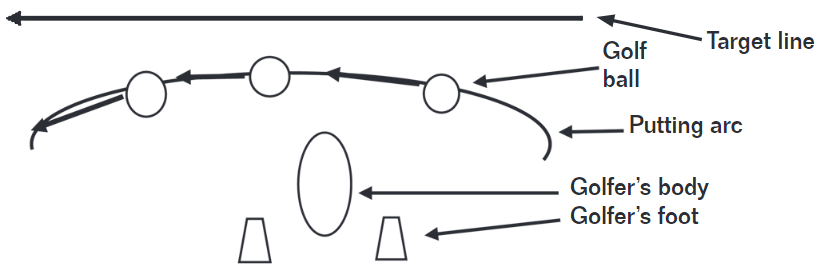
We practice trying to take the putting stroke straight back and straight through. With the conventional stance, we are fighting biomechanics and the laws of physics. When we stand erect, our arms swing around the body in an arc and so does the putter head. Ball placement in this arc must be accurate or the ball will go to the right or to the left of the target.
Select your putter. The length of the putter does not matter. Just remember, with the long putter, do not anchor the end of the putter to your body. Instead, you will anchor your elbow nearest the target to the side of your body. This stabilizes the top hand for the putting stroke. The length of the putter will determine the amount your body will bend over.
The top hand or arm anchors to the body with the elbow no matter the length of the putter. This arm is your stabilizer. It stabilizes the putter for the stroke. The lower hand assumes a split grip that can vary in length, but give it a good split because this is your putting stroke just like you rolled the ball to the target with your hand.
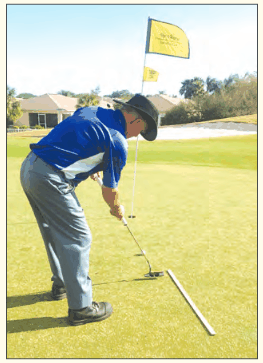
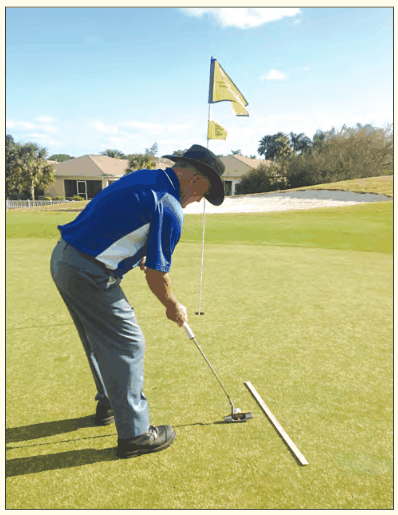 This is the stance. An open stance is used to aid in the putter moving straight back. The front elbow is locked to the body instead of the putter locking to the body. Individual preference will determine the amount of open stance needed. The yard-stick shows the target line.
The body is in an open position, very much open, at least 45°. As you will notice in the photos, simply pull the back arm and elbow back and then push the forearm forward through the ball to the target. You will notice the putter head go straight back and straight through naturally to the target. This is the key. The open stance gives the pull-back by the elbow a straight line to the stroke and target. This is natural and within the laws of physics; no adjustments to the swing are made. The putt must go straight.
Try this. With a ball in hand, roll it to a target and notice how far your hand swings back and through. Do this several times until you get a good feel as to how far the ball rolls with how far your hand swings back. Do the same thing with different targets and different lengths. Now take your putter and putt the ball to these targets. You will notice and feel how the hand swung back the same distance with the putter as when you rolled the ball to the same target.
I taught this to a club pro, and his routine for every putt would be to swing his arm with an imaginary ball to the target. He then got the feel for the putt’s distance. He would then stroke the ball to the same arm swing. He qualified for the U.S. Open.
As an aid to distance control, some have found that for every inch of backswing the ball will roll 1 foot or 2 feet depending on the individual. Some will take their putter and use the length of the putter blade to determine their backswing length. If the putter is 4 inches long, a golfer can measure 4, 8, 12 inches, etc., for his backswing length. The golfer can then place the back foot at this length and swing the putter back to the toe and then through the ball.
As you go to putt, look at the hole and feel the distance. Then look at the ball and stroke the ball quickly. Wait too long and the feel will be lost. Do not tell yourself how hard to stroke the ball. The eyes know and have told the body. As you stroke the ball, keep the image of the target’s distance in your mind and let the feel just hap-pen as you did when you rolled the ball from your hand.
The elbow pulls back. The body is stationary. Notice how the putter blade has moved straight back. No arc.
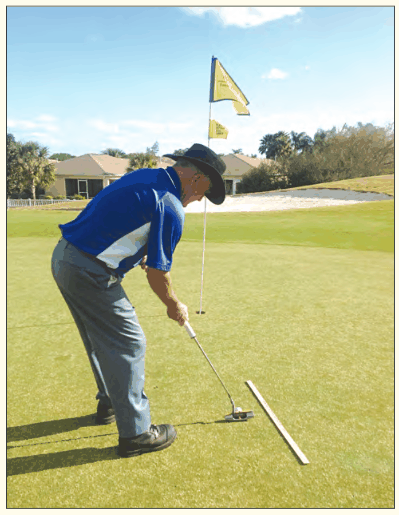
Notice how the putter blade has moved through the ball in a straight line as the back forearm is pushed to the target. No body movement except for the back shoulder which will have moved slightly to the target after the ball has been struck. The front arm is a stable rod and the back arm is a piston pushing the ball to the target.